
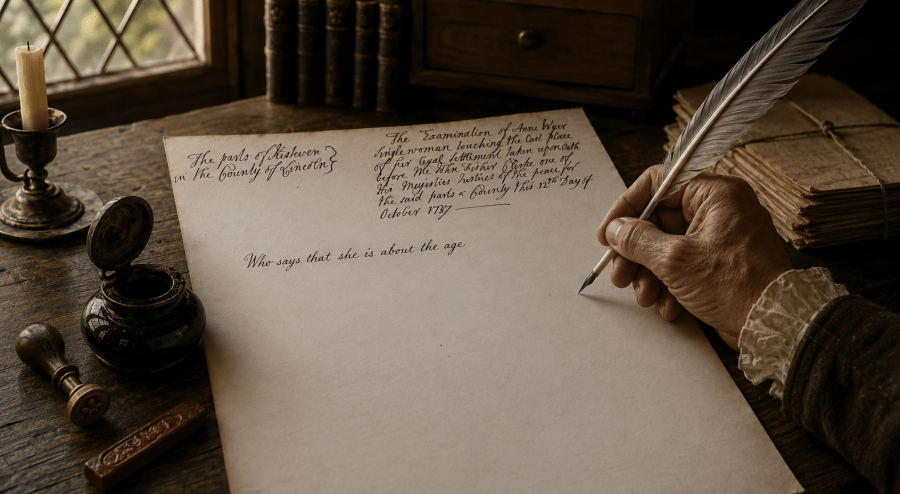
How a Forgotten Document brought a Young Woman to Life
FAMILY HISTORIANS QUICKLY become accustomed to working with fragments of lives. A baptism tells us when someone entered the world; a marriage listing marks the beginning of a new family; a burial entry records the final chapter.
Among genealogists these are known as ‘hatches, matches and despatches.’
Between those milestones, however, there is often silence. The everyday lives of ordinary people — where they worked, who they knew, the hardships they endured — are all too easily lost.
Occasionally, however, history offers something quite extraordinary.
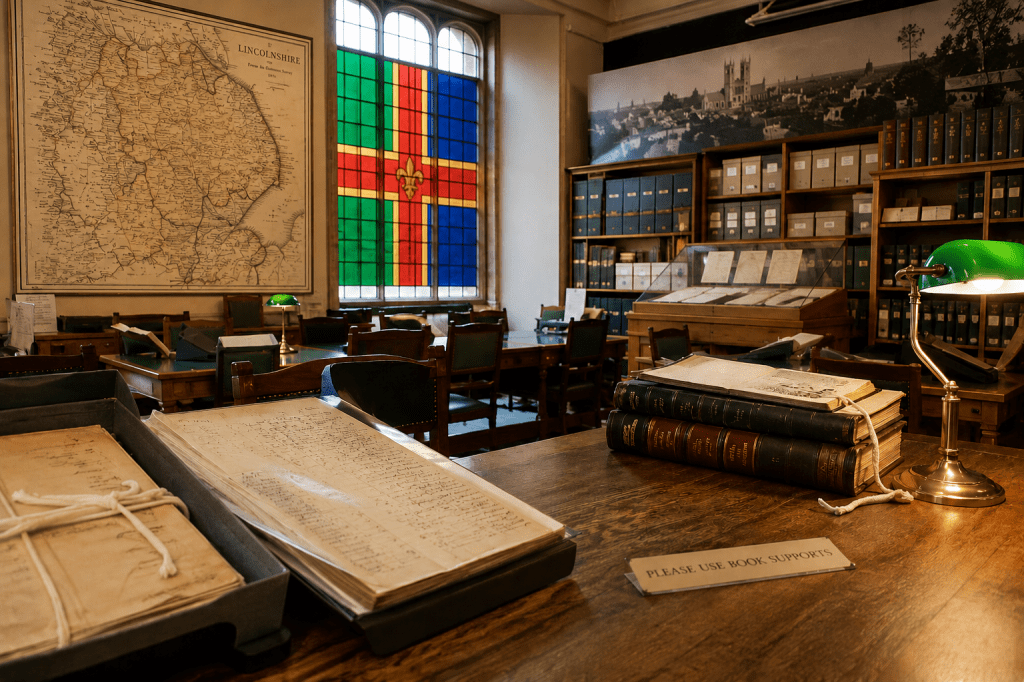
While conducting my own research at the Lincolnshire Archives some years ago, I came across an unassuming legal document. It was entitled simply The Examination of Anne Wyer.
At first glance it appeared to be little more than another piece of parish administration, written in the dense legal jargon, familiar to anyone who has spent time among such records.
I filed it away and forgot about it — until a few days ago.
While searching for an unrelated document, I uncovered the sheet again. I looked more closely at it. And as I began to decipher the faded ink, something remarkable happened.
A young woman by the name of Anne Wyer began to emerge from the page.
Her appearance was not through letters or diaries—she could not even write her own name—but through answers she gave under oath more than two hundred and thirty years ago.

A document that began as a routine legal enquiry slowly unfolded into a vivid account of a young woman’s life, her work, her illness and the uncertain world she inhabited.
Why was Anne Questioned?
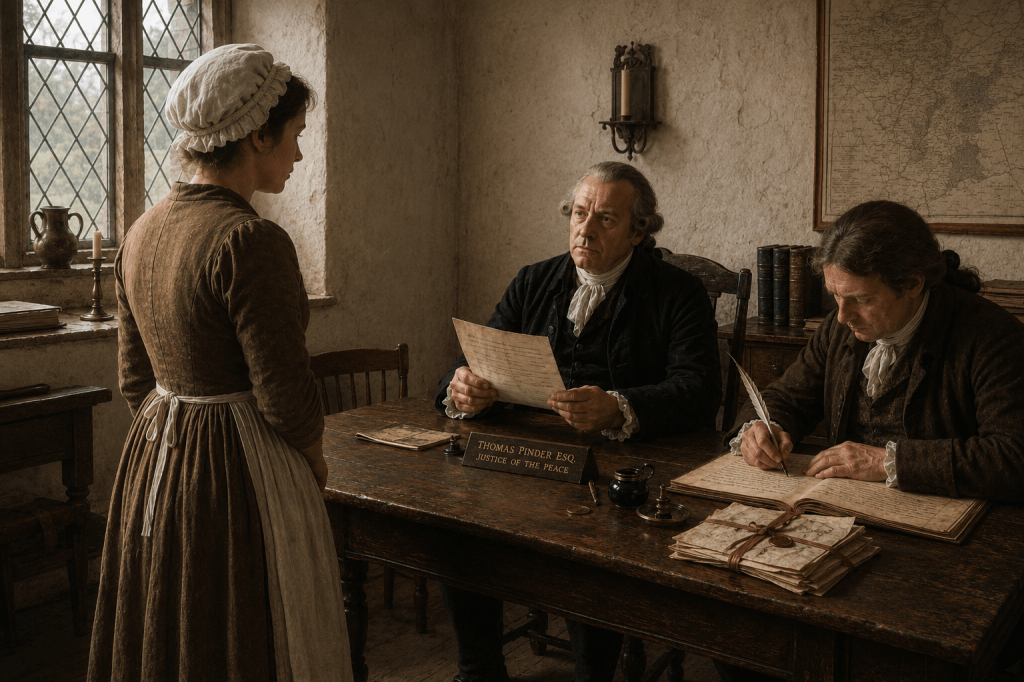
TO UNDERSTAND THE document, we must first step back into Georgian England.
Under the Old Poor Law, introduced in 1601, each parish was responsible for supporting its own poor. There was no national welfare system. Instead, every parish raised its own poor rate and used that money to care for local people who were unable to support themselves.
That simple arrangement, however, created an important question.
Who actually belonged to a particular parish?
A person’s legal settlement did not necessarily depend upon where they happened to be living. It could be established through birth, apprenticeship, marriage or the completion of a year’s lawful service.
When someone fell into poverty or became incapable of working, parish officers naturally wished to know whether the responsibility for supporting that individual lay with them—or with another parish entirely.
That was the purpose of Anne’s examination.
She was not accused of any offence. She had committed no crime. The magistrate simply needed to establish where the law said she belonged.
Ironically, it is because the questions were so thorough that Anne’s life can now be reconstructed in such remarkable detail.
Following Anne’s Footsteps
ANNE EXPLAINED THAT she had been born in Billingborough, where she lived with her parents until she reached adulthood. She gave her age as ‘about’ twenty-five years.
Like many young women of the period, she then entered domestic and agricultural service, first serving John Perkins, a husbandman of Horbling. She completed not one but two successive yearly hirings with him, an important detail because a full year’s service could create a new legal settlement.
Later she entered service with John Thompson of Elsthorpe, in the parish of Edenham. When Thompson died before her year’s hiring had expired, Anne continued in the employment of his widow, accompanying her when she moved to Hacconby so that the original contract could be completed.
Her next position was with Mary Scott, wife of Hugh Scott, of Hacconby.
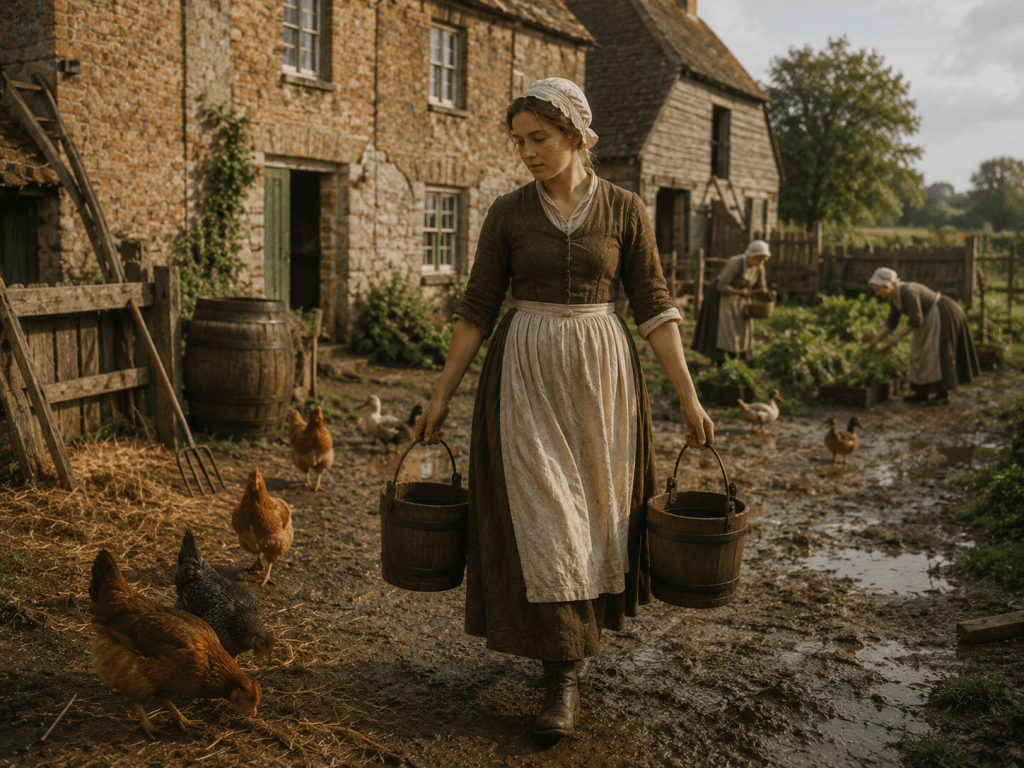
Up to this point, Anne’s story resembles that of many young rural servants. She moved from household to household as opportunities arose, gradually building a working life across the villages of south Lincolnshire.
Then her fortunes changed.
Anne’s Illness
WHILE IN THE Scotts’ service Anne became seriously ill.
Unable to continue her work, she asked Hugh Scott to release her from her contract and allow her to return home.
He agreed.
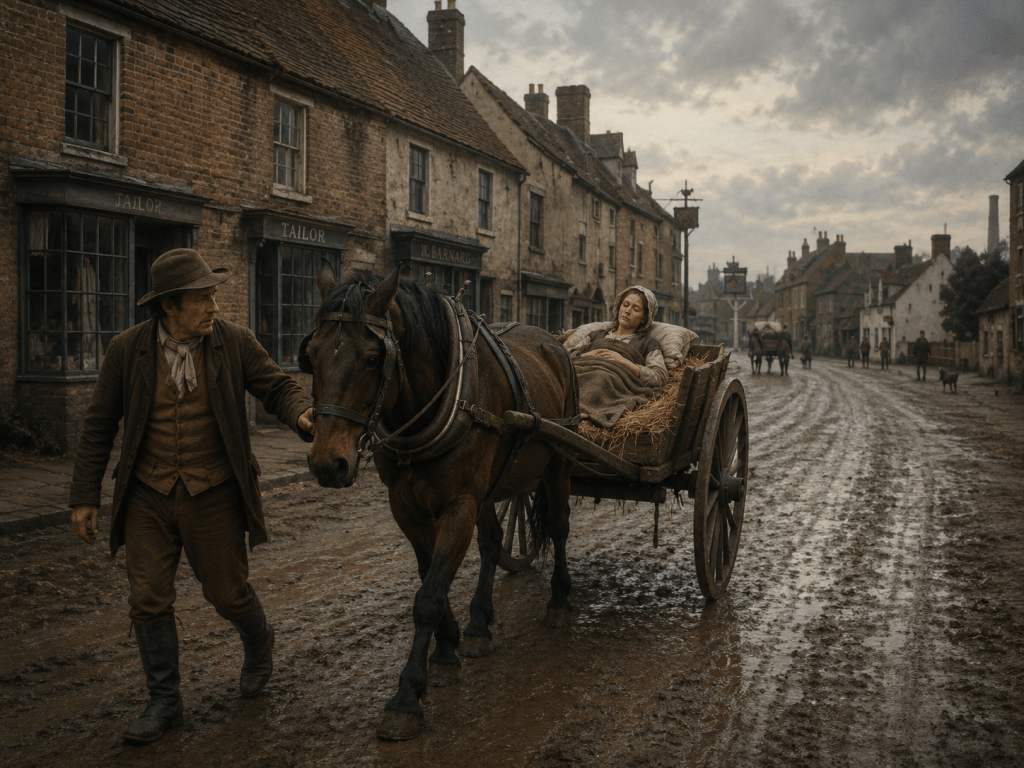
Her uncle, John Hardy, came from Billingborough, collected her in his horse and cart, and took her back to the family home, where she remained for several days while recovering.
Had the examination ended there, it would already have provided family historians with a remarkably intimate glimpse into Anne’s life.
Instead, the story takes an unexpected—and rather puzzling—turn.
After only a few days with her uncle, Anne was once again placed in a cart.
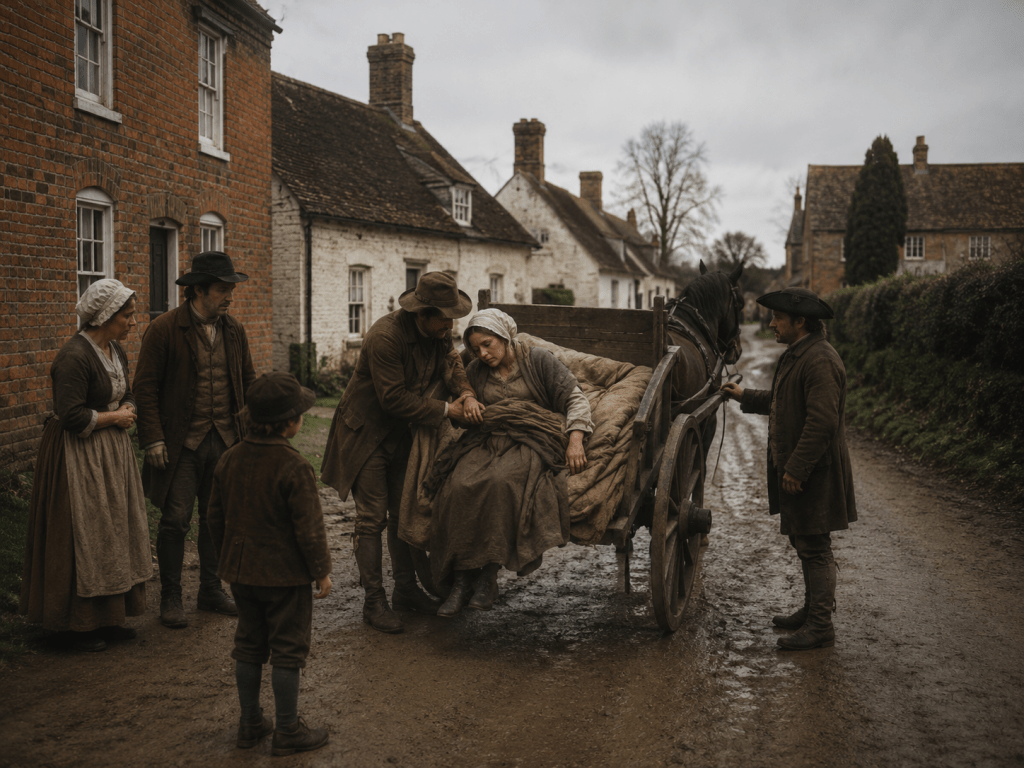
This time she was driven by a labourer named Thomas Sutton back towards Hacconby. At this point, the examination records that she was ‘laid down in the street.‘
It is one of the most striking phrases in the entire document. To modern readers it sounds shocking, even cruel. Had Anne simply been abandoned?
The answer is almost certainly no, although the wording reflects the practical realities of eighteenth-century life.
Anne was evidently still too weak to travel independently. The phrase ‘laid down‘ almost certainly means she was helped from the cart and placed on the ground because she could not stand or walk unaided. Nevertheless, the image is deeply evocative: a young woman, weakened by illness, deposited in the village street while others determined what should happen next.
Her journey did not end there.
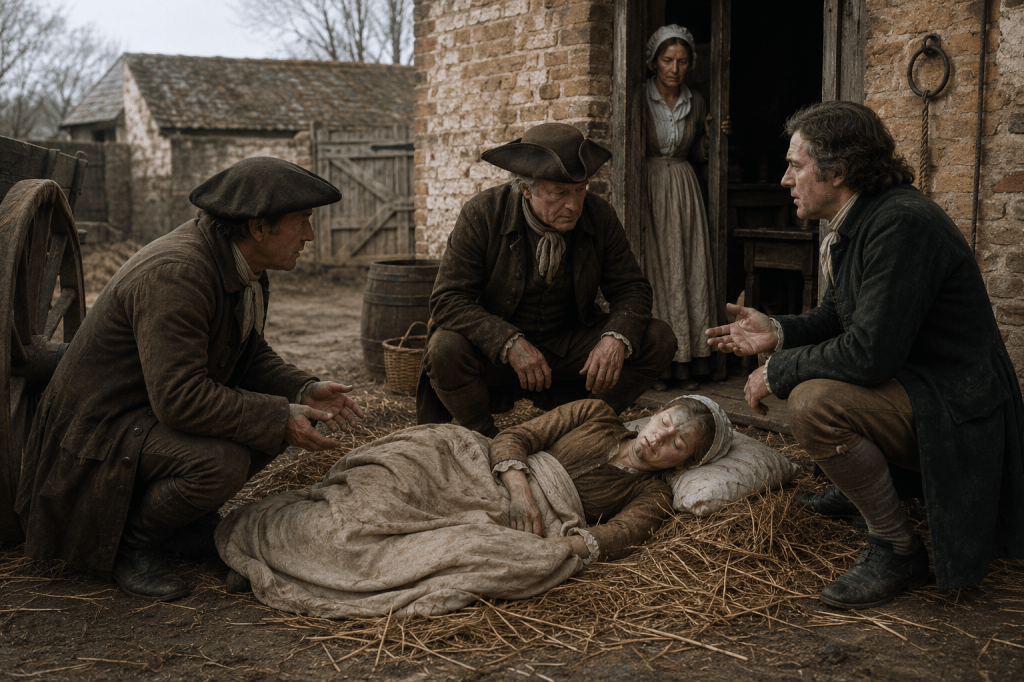
The following day—or perhaps the day after—she was carried once more, this time to Elsthorpe, where she was laid in the yard belonging to Hugh Scott by William Moor, the village victualler.
Why should a sick servant be transported from one village to another in this way?
The answer almost certainly lies not in medicine, but in law.
The Hidden Legal Drama
EVERY MOVEMENT ANNE made had the potential to affect her legal settlement.
Who had dismissed her, for example? Had she left voluntarily? Where exactly had she been living when illness overtook her? Which parish was responsible for her if she could no longer earn her living?
These were not abstract questions. They determined which community would bear the financial burden of supporting her. And read in that light, the seemingly unnecessary detail suddenly becomes understandable.
Note that the clerk carefully records who owned the cart, whose horse pulled it, who drove it, who later carried Anne onwards, and where she was physically placed at each stage of the journey. Such details were not included for colour or curiosity; they were evidence.
What appears today as a strangely dramatic episode was, in all probability, part of a legal dispute between neighbouring parishes over responsibility for Anne’s future support.
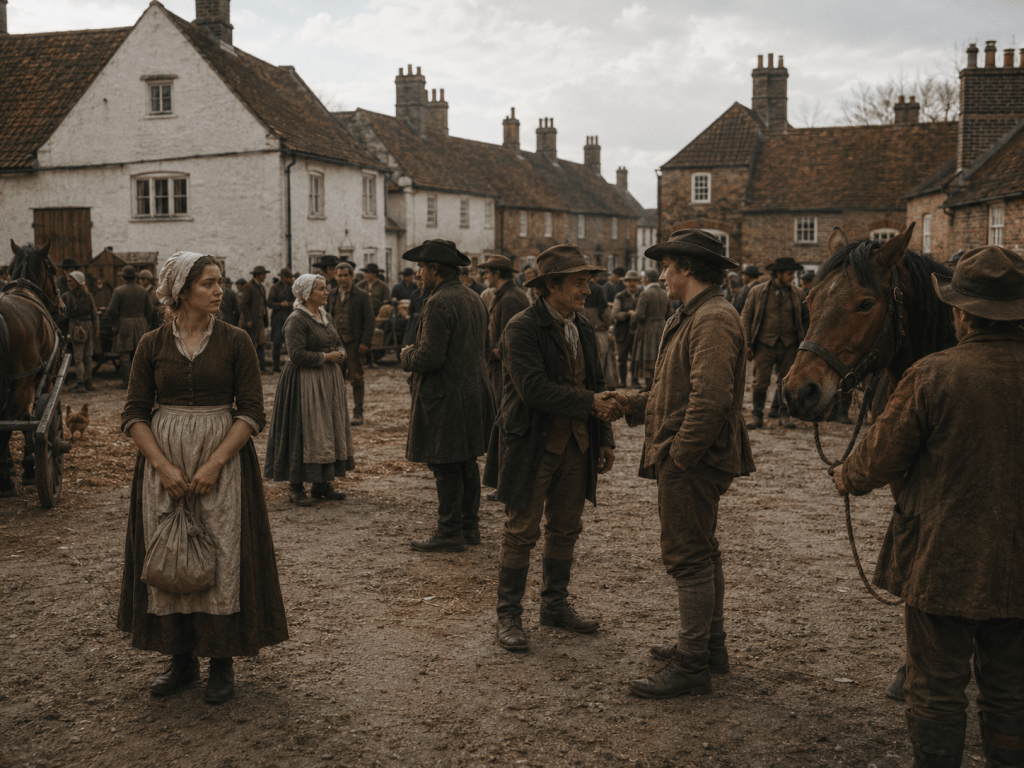
This single document tells us far more than any parish register ever could. For here, we discover not simply where Anne lived, but how she lived. We see a young woman whose life was governed by annual hiring contracts, whose employment depended upon good health, and whose security could disappear almost overnight.
We also see the importance of family, with an uncle travelling by horse and cart to bring her home when she could no longer care for herself.
We also witness employers, neighbours and local tradesmen becoming participants in what was ultimately a legal process.
Most importantly, we catch fleeting glimpses of Anne herself.
She appears practical and resilient. When illness made it impossible to continue working, she did not simply disappear from the record. Instead, she asked to leave her employment by mutual agreement, accepted the care of her family, and later recounted every stage of her experience with sincere clarity before the magistrate.
Why Such Documents Matter
WHEN MANY PEOPLE think of family history, they imagine parish registers, census returns or photographs. Yet some of the richest discoveries lie hidden among the administrative records that few researchers ever consult.
Settlement examinations were never intended to preserve personal histories. They were created solely to answer legal questions raised by the Poor Law.
Yet in asking where a person belonged, they often reveal where that person had been, who they worked for, who cared for them and how they navigated the hardships of everyday life.
Anne Wyer’s examination is one such document.
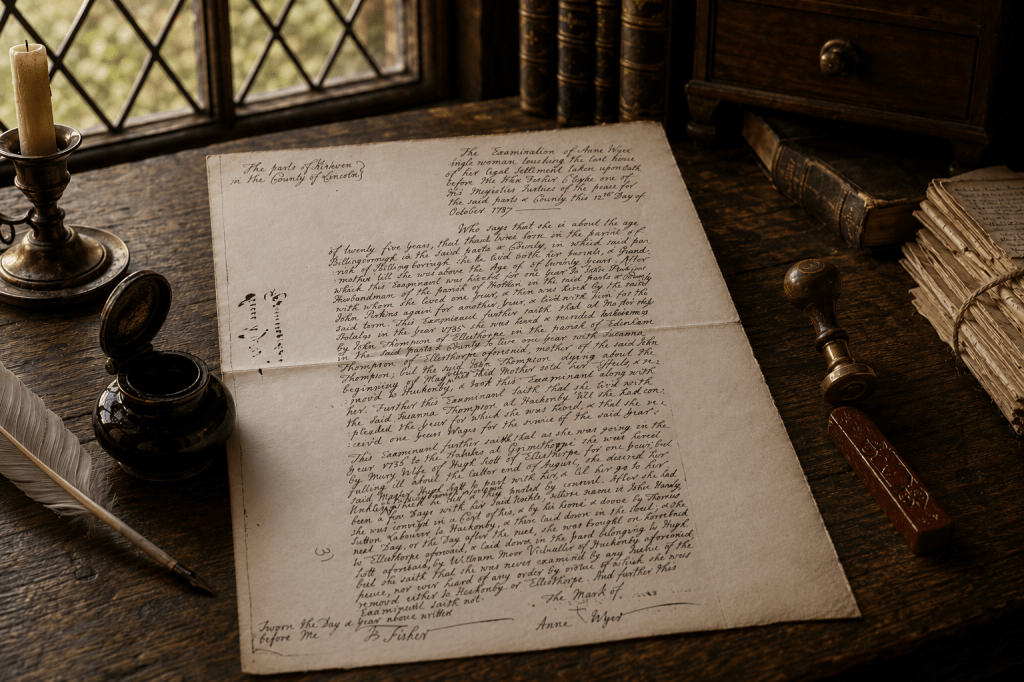
It allows us to trace her movements across the villages of south Lincolnshire, to witness the uncertainty of life in domestic service, and to glimpse the practical workings of the eighteenth-century Poor Law.
Above all, it reminds us that history is not merely the story of famous men and great events. It is also the story of ordinary people whose lives survive almost by accident.
More than two centuries after Anne stood before a Justice of the Peace to answer routine legal questions, those answers have become something far more valuable than anyone present could have imagined.
They have become her story.
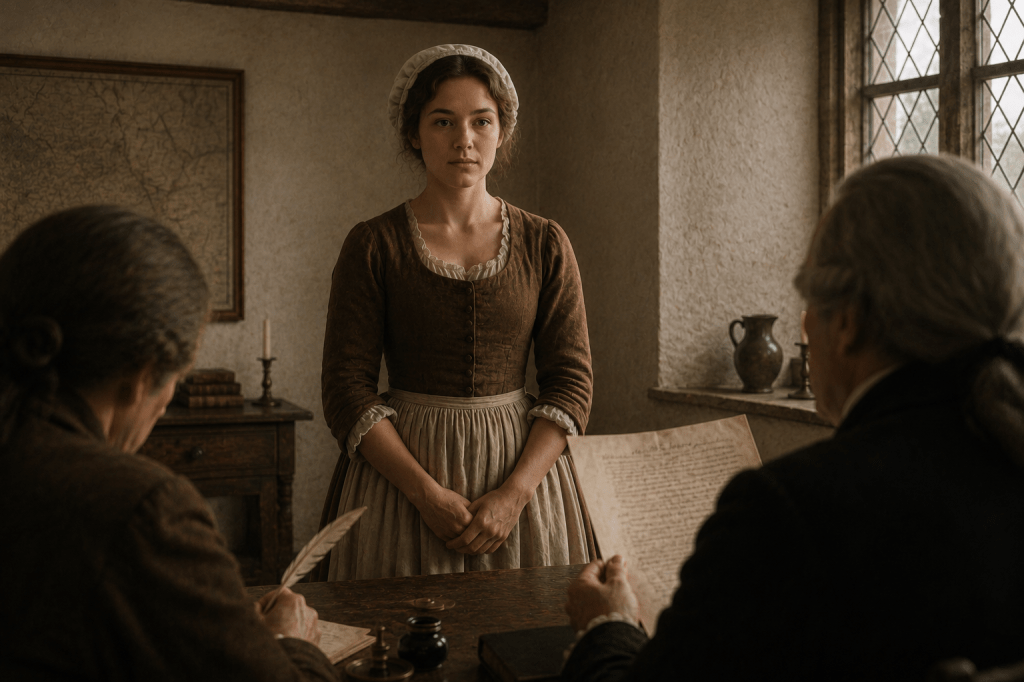
A Final Thought
WHEN I FIRST discovered Anne Wyer’s examination in the Lincolnshire Archives, I viewed it as a dry legal record. Instead, more recently, I found a young woman stepping out from the shadows of the eighteenth century.
Every faded line of ink carried another fragment of her journey: the villages where she worked, the people who employed her, the uncle who came to her aid, the neighbours who helped move her from place to place, and the legal machinery that shaped the lives of England’s rural poor.
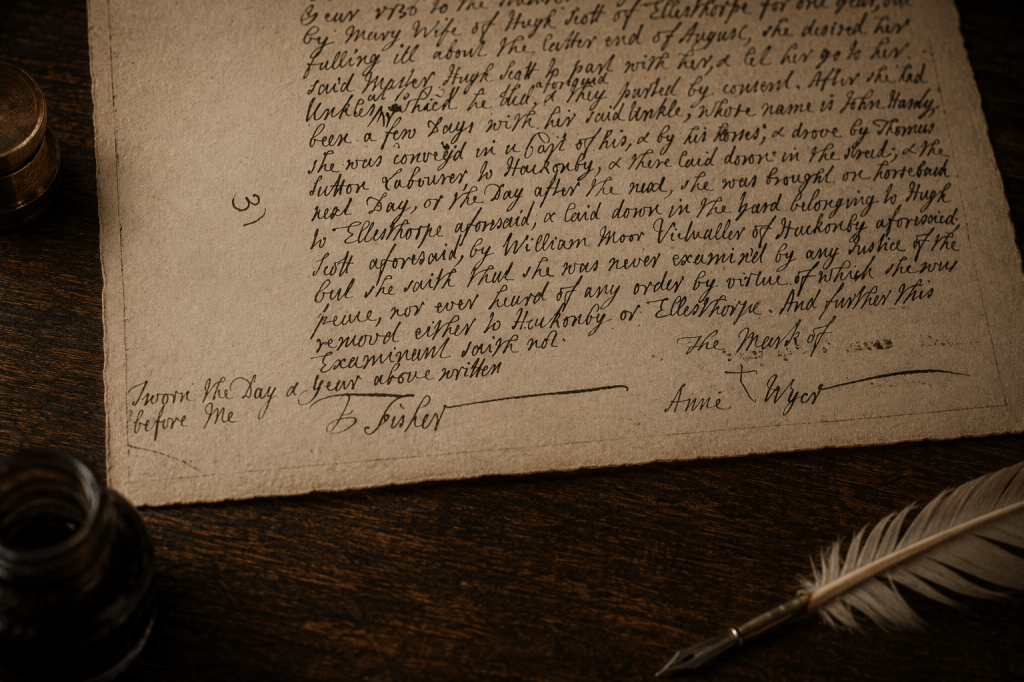
For a family historian, there can be few greater rewards than that. We do not simply discover names; we recover lives. And thanks to one fragile manuscript, Anne Wyer’s life can once again be told.

 RAVEN MOON