
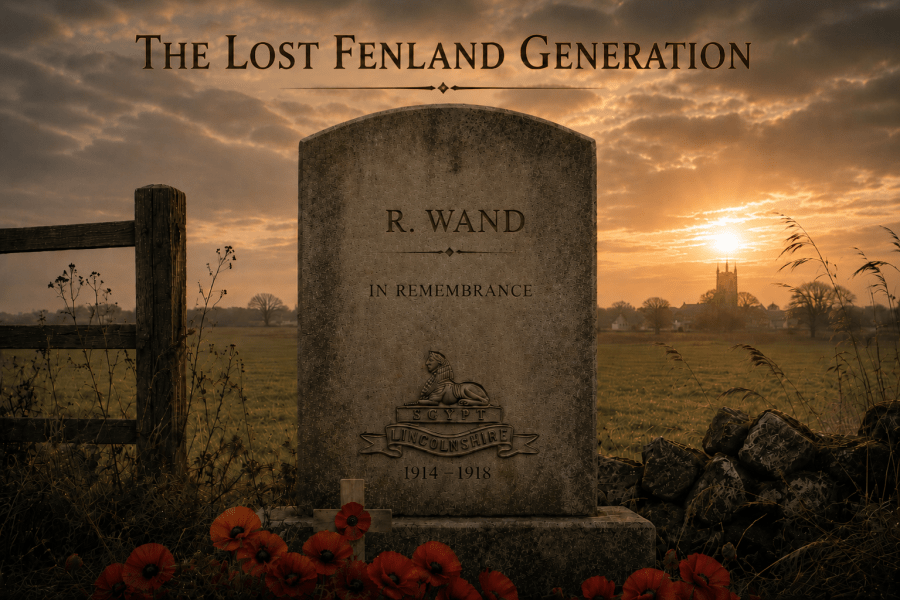
The Horseman Goes to War
IIN THE SUMMER of 1914, Hacconby and neighbouring Stainfield were quiet Lincolnshire farming communities whose rhythms had altered little for centuries.

Spring brought ploughing and sowing. Summer promised long days for haymaking and harvest. Autumn filled the barns with wagonloads of grain and winter feed, while winter offered little respite beyond repairing hedges and dykes, tending livestock and preparing for another year.
As July rolled into August that year few could have imagined that events unfolding hundreds of miles away in continental Europe would soon reach into almost every household.

Like thousands of villages across Britain, these small parishes answered the nation’s call to arms. Young men left behind them the farm, the field and the forge to exchange working clothes for khaki uniforms, flat caps for helmets, hoes for rifles.
They served wherever they were called to go: France and Belgium, the Dardanelles, across Egypt and Palestine. Those fortunate enough to survive the conflict would journey home once more. Tragically, however, twelve young men from these two rural communities were destined never to return.
Their loss reached far beyond the unremitting grief of parents, wives and children. In villages where every able pair of hands contributed to the life of the community, the death of a son or husband could also mean the loss of a labourer, a horseman, a craftsman ― a breadwinner.
Fields still required tending, livestock demanded care, and families already living close to poverty faced uncertain futures without those upon whom they depended.
Today, names of the twelve remain carved into memorials of stone. Yet behind every inscription lies a story waiting to be rediscovered.
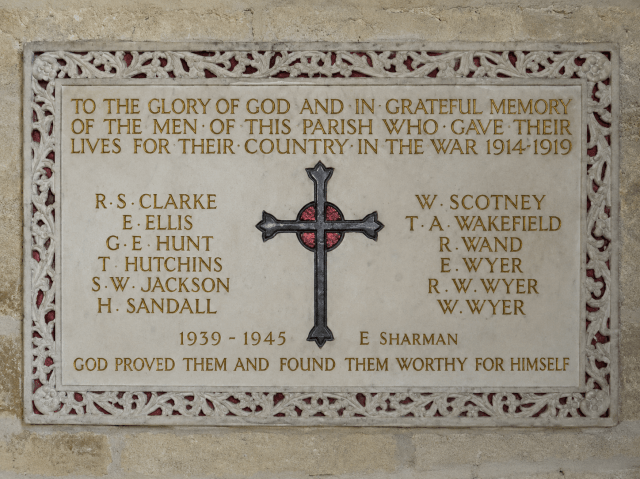
This is the story of one of them – my second cousin, three times removed, Robert Wand.
ROBERT WAS BORN in Hacconby during the summer of 1883 and baptised in the ancient church of St Andrew on 5 August that year. He was the youngest of six sons born to Richard Wand and his wife Sarah Ann, née Ellis, both members of two long-established local families whose roots in the district stretched back through generations.
Richard earned his living as an agricultural labourer, work that demanded strength, endurance and resilience. Like thousands of rural labourers throughout the county, he depended upon the fortunes of each farming season. There was little security beyond hard work and few prospects beyond the village and neighbouring parishes.
For young Robert, this was the only world he knew.

His earliest memories would have been shaped by the sights and sounds of Victorian rural England: horses clomping along narrow lanes, the smell of freshly turned earth, church bells on a Sunday morning, and the changing colours of the surrounding countryside as one farming season yielded to the next.
The census of April 1891 records him simply as a nine-year-old scholar. There is nothing remarkable about the entry, yet therein lies its charm. Like countless village children, Robert’s life appeared comfortably predictable. School occupied his weekdays, home his evenings, and the surrounding fields offered endless opportunities for youthful adventure.
No one reading that census at that time could possibly have imagined where life would eventually carry him.
By the time the following census was taken, ten years later in March 1901, Robert had left school and entered the occupation that would define his adult life. He was employed as a horseman.
To modern readers the title may seem little more than a quaint description, but on an Edwardian farm it represented one of the most trusted positions amongst the workforce. Before the arrival of tractors, horses provided the motive power upon which every successful farm depended.
They ploughed the fields, hauled carts laden with grain, transported livestock, drew harvesting machinery and carried produce to market. A reliable team of heavy horses represented a considerable investment, and their welfare rested largely in the hands of the horseman.

Robert’s day would have begun long before sunrise.
He would make his way to the stables by lantern light while much of the village still slept. The horses came first.
They were fed, watered, groomed and carefully examined before harnesses, polished by years of work, were lifted onto broad backs.
Only when every animal was ready could the day’s labour begin.

Through spring he would guide the great horses steadily across heavy fenland soils as the plough turned fresh furrows. During summer they hauled hay and implements beneath an open, sun-bleached sky.
Harvest demanded even longer hours as loaded wagons creaked from field to stackyard. In winter there were hedges to repair, manure to spread and timber to haul.

Whatever the season, the horses required the same patient care at the end of every working day as they had at its beginning.
It was physically demanding work, yet it also required patience, judgement and calm authority. A frightened team weighing several tons could quickly become dangerous. A good horseman therefore relied less upon force than understanding. The finest teams responded almost instinctively to familiar voices and gentle commands.

By 1911, Robert had left Hacconby and was living in nearby Dunsby, in the home of farm foreman, George William Martin. By that time, Robert’s occupation had become that of waggoner, reflecting increased responsibility rather than a change of trade.
He was now entrusted with transporting heavy loads across the countryside, standing beside broad-wheeled farm wagons drawn by powerful Shire horses whose steady strength remained the backbone of Edwardian agriculture.

Neighbours would have recognised him immediately. A familiar figure upon the winding lanes, reins held loosely in experienced hands, guiding patient horses whose pace had not altered from that of previous generations.
Although the work brought neither wealth nor prestige, it did, instil habits that would later serve him well: reliability, endurance, self-discipline and an ability to shoulder responsibility without complaint.
Those qualities cannot be measured by census returns. Yet the Army would soon recognise them.
THE FIRST DAYS of August 1914 shattered assumptions that had endured for generations.

Britain’s declaration of war reached every quiet village with astonishing speed. Newspapers carried reports of mobilisation. Recruiting meetings were organised in nearby towns. Railway stations soon witnessed emotional farewells as volunteers departed for training camps.

For farming communities, the consequences were immediate.
August was the great harvest month. From first light the fields echoed to the rasp of scythes and the rattle of binders, horses strained against loaded wagons, and every able hand was pressed into service, for the success of a year’s labour depended upon gathering the corn before the weather broke.
Every young labourer who enlisted left another empty place in the fields, the stables, the stockyards. The nation’s need now extended far beyond agriculture and it required young, physically fit men.
Robert was thirty-one years old. Unlike many enthusiastic teenagers who flocked to recruiting offices, he was already an experienced working man whose life seemed firmly established. Nothing suggests he sought adventure. Everything about his background points instead towards a focused sense of duty.

On 8 September, 1914, barely one month after Britain entered the war, Robert journeyed to nearby Bourne where he enlisted in the Lincolnshire Regiment.
His attestation papers, whilst scarred by fire damage sustained during the blitz of a later world war, preserve a remarkable portrait of the man who stood before the recruiting sergeant.

Robert measured five feet five and a half inches in height, weighed 138 pounds, possessed brown hair and brown eyes, and described his occupation simply as Horseman.
Unlike many volunteers joining Kitchener’s New Army, Robert enlisted into the 3rd (Special Reserve) Battalion.
Its purpose differed from that of the Service battalions then being raised across Britain. Rather than fighting overseas itself, the Special Reserve trained soldiers before sending them as reinforcements to battalions already serving on active operations.
For almost a year Robert remained in Britain.
During that time the Army discovered much the same qualities his previous employers already knew and valued, and on 12 March, 1915 he was appointed Lance-Corporal without pay.
Two months later, on 11 May, the appointment became substantive.

Promotion after only six months was by no means automatic. It reflected confidence in his reliability, steadiness and ability to lead others.
One cannot help wondering whether those years spent quietly directing powerful horses across the fields of Hacconby had already taught him lessons in patience, responsibility and calm authority that military training merely refined.
THE WAITING FINALLY ended on 10 September, 1915. Robert embarked for France.
No letters home or diary survives describing his thoughts as the English coastline slipped slowly astern. Yet it requires little imagination to picture the emotions felt by a man whose world had rarely extended beyond his home community.
Within hours of leaving port he entered an altogether different landscape.
The peaceful fields of Lincolnshire gave way to trenches stretching towards the horizon, shattered villages and the relentless thunder of artillery that had echoed across northern France for more than a year.
Only sixteen days after arriving at the front, he was wounded.

His surviving service papers record that on 26 September, 1915 he received a gunshot wound to his right forearm. Evacuated across the Channel, he entered the Military Hospital at Canterbury on 4 October before being discharged only five days later.
Robert had survived his first experience of battle, and soon he would return to his comrades.
His greatest trials, however, still lay ahead.

 RAVEN MOON