

Wills and Continuity in the Sandall Family
WHEN WE THINK of inheritance in eighteenth-century rural England, we often imagine little more than the passing of possessions after death.
But the wills left behind by members of the Sandal family of Rippingale suggest something altogether more deliberate.
These highly-informative documents reveal ordinary villagers thinking strategically about security, continuity and survival.
They achieved this not through grand estates or landed wealth.
But through looms, household goods, carefully-measured cash gifts and the controlled transfer of productive assets.
Read together, wills such as those of my 7x great grandfather, Robert Sandal, a weaver, and great x7 great-uncle, Isaac Sandal, who was a tailor, offer an unusually intimate glimpse into how one Rippingale family attempted to preserve stability across generations.

Agricultural Craftsmen
RURAL LIFE IN south Lincolnshire was never as straightforward as later nostalgia sometimes suggests.
People did not always confine themselves neatly to a single occupation. Even in a farming community such as Rippingale, families often combined agricultural involvement with skilled trades, creating flexible household economies.
The Sandals appear to belong to this world. Robert identified himself as a weaver; Isaac, twenty years later, as a tailor.
Neither occupation placed them among the wealthy. Yet both men left evidence of something valuable: shrewd planning.
ROBERT SANDAL: PRESERVING THE MEANS OF PRODUCTION
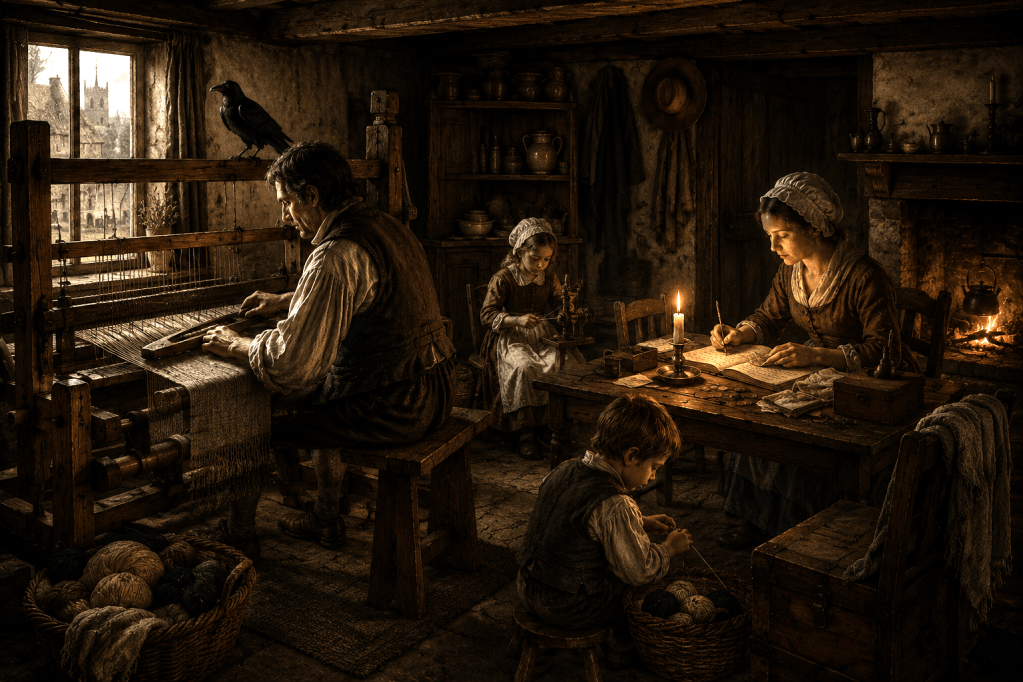
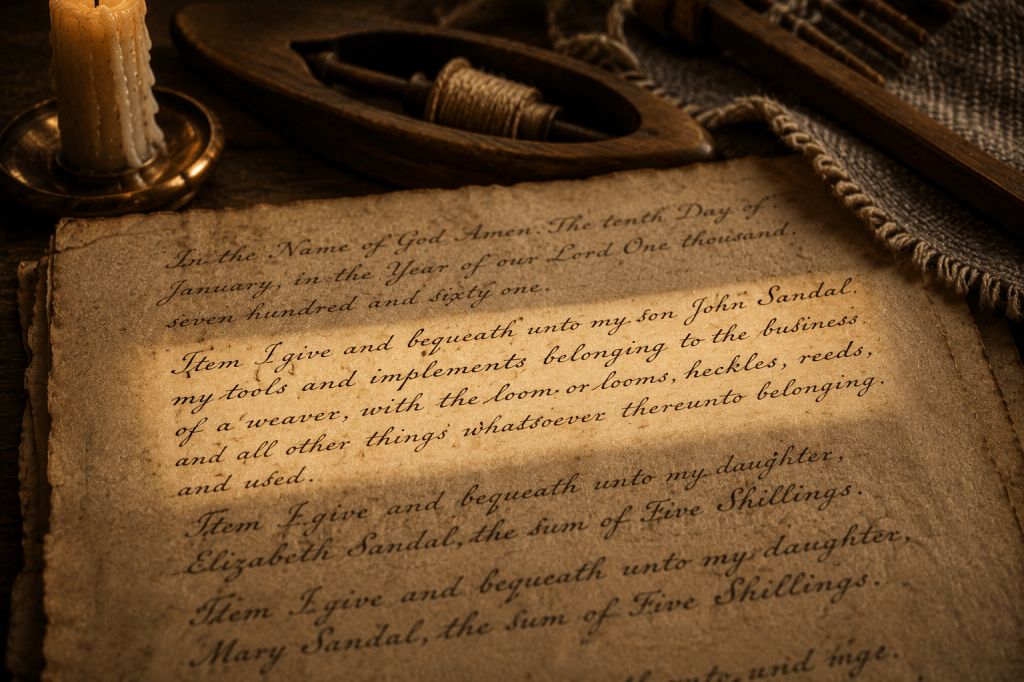
Robert’s will, written in January 1761 and proved that December, appears at first to follow familiar patterns.
- Children receive small sums.
- Household goods are distributed.
- His widow Jane receives protection and provision.
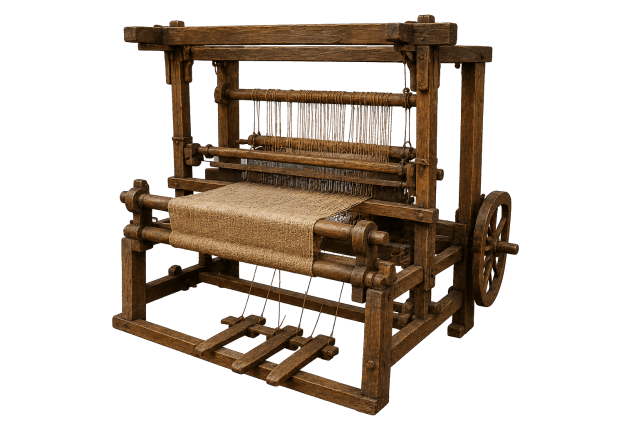
But beneath the ordinary language lies a carefully structured economic plan. For among Robert’s most important bequests was not money but equipment.
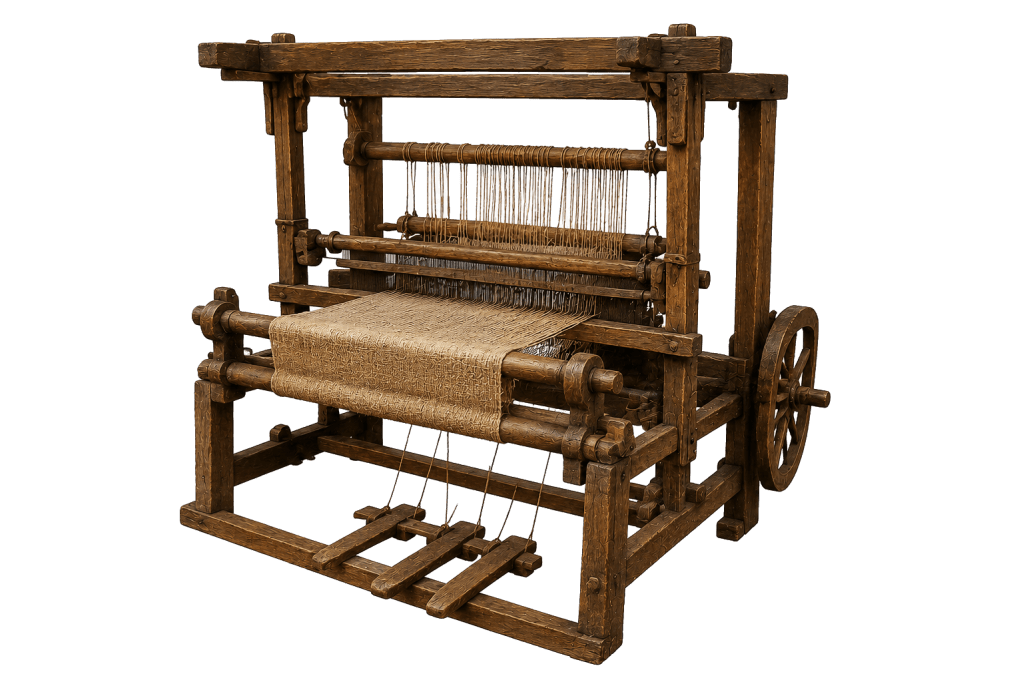
” … I give to John Sandal my son my shop of tools and implements belonging to the business of a Weaver, that is two looms warping fat and gears and every indivisible that belongs to the said business of a Weaver … “
Accordingly, Robert’s son John inherited the tools of the weaving trade — including looms and associated apparatus used in textile production. And this decision was key.
A loom was not furniture. It was capital.
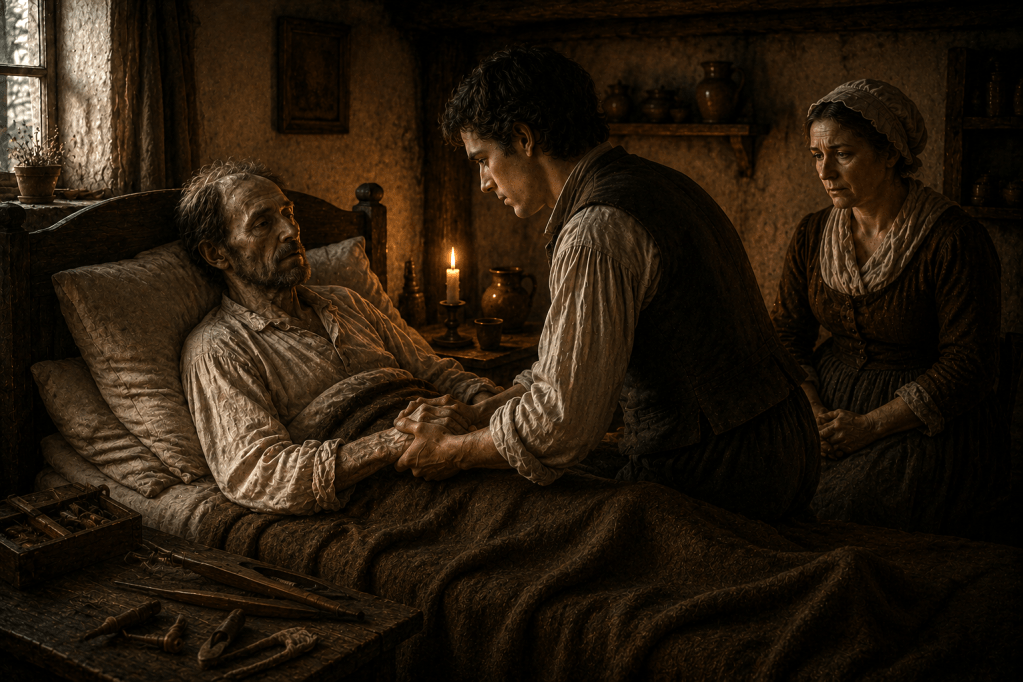
By preserving the workshop intact rather than dividing its value among heirs, Robert ensured that one child inherited the ability to continue earning. This was nothing less than astute succession planning in practical form.
The widow’s provision reveals similar thinking.
Jane received use and enjoyment of household property for so long as she remained his widow.
” … I give to my wellbeloved Jane my wife, whom I likewise constitute make and ordain my sole Executrix of this my last Will and Testament, and all and singular the remaining part and rest of my good, chattels and household furniture by her freely to be enjoyed so long as she continues my widow, which if she should marry again, I will that she pay or give to my son John Sandal or his heirs or assigns the sum of ten pounds of good and lawful money of England … “
The intention seems clear: protect her security while preserving the household economy for the next generation.
ISAAC SANDAL: CONCENTRATING ASSETS
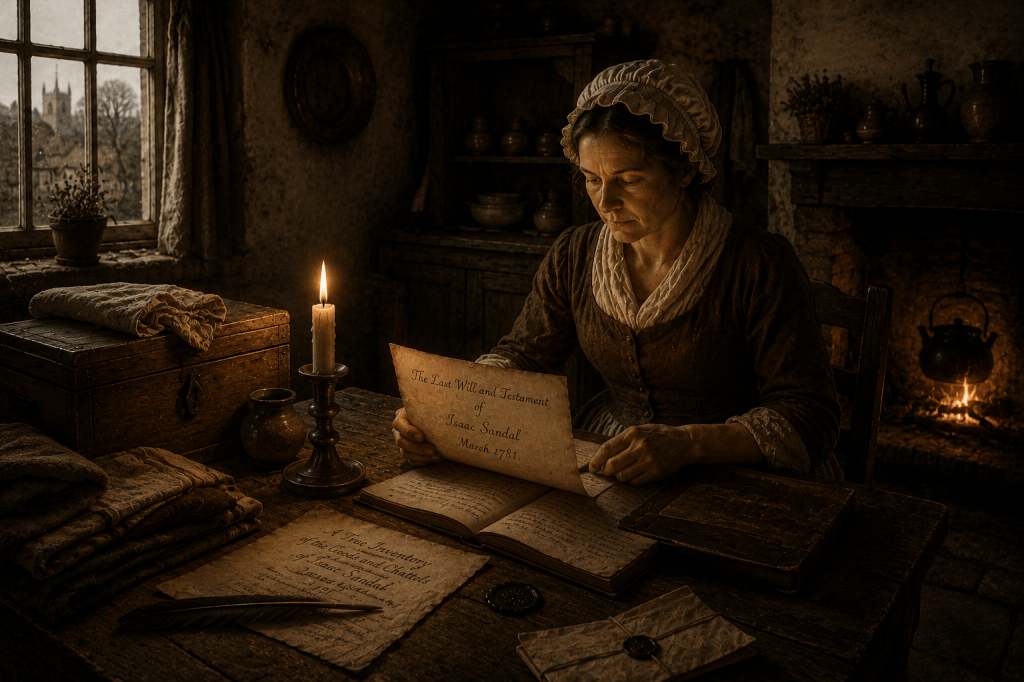
Two decades later, Isaac’s will reveals a subtly different strategy.
Isaac leaves token sums to his daughter Mary and son Joseph.
“First I give to my daughter Mary the wife of John Wyer the sum of one guinea. Secondly I give to my son Joseph Sandal of Wisbech the sum of one guinea.”
The remainder of his estate, however, passes to his wife Elizabeth, who is appointed sole executrix and receives broad authority over his goods and chattels.
“Thirdly and lastly I give to Elizabeth my beloved wife, whom I likewise constitute make and ordain my only and sole Executrix of this my last Will and Testament all and singular my goods and chattels by her freely to be enjoy’d.”
Unlike Robert, Isaac does not appear concerned with distributing assets immediately among heirs.
Instead, he consolidates them.
This may reflect a smaller estate, different family circumstances or a judgement that household stability mattered more than early division.
Whatever the reason, the intention appears similar.
Family security first. Inheritance later.
Landholding & Enterprise
WHAT MAKES THE Sandall family particularly revealing is that their story does not end with the wills of Robert and Isaac.
Across successive generations, the family appears repeatedly in occupations that combined craft, labour, landholding and enterprise.
Robert Sandal, who died of consumption in 1761, was a weaver whose will carefully preserved the tools and infrastructure of his trade for his son John.
Two decades later his brother, Isaac Sandal, appears as a tailor.
By the early nineteenth century, other members of the family had expanded further into property occupation and mixed economic activity.
Daniel Sandall held a public house and later worked as a mason, while Thomas Sandall occupied a smallholding before acquiring freehold and copyhold land in Gosberton and Thurlby.
This gradual progression is highly relevant.
It suggests that the careful management of tools, household goods, widow’s provision and inheritance may have done more than preserve stability. It may have enabled advancement. For example, as we have seen, the weaving tools left by Robert were not simply objects. They were productive capital.
And over time, the income and security generated by such assets may have helped later generations accumulate land, property and greater independence.
Seen this way, the Sandals embody a wider truth about rural Lincolnshire society:
For many village families, survival depended upon flexibility — but improvement depended upon continuity.

Wills as Financial Instruments
THESE DOCUMENTS REMIND us that village families thought carefully about risk. Death was not only inevitable, it threatened income, tenancy, household structure and future opportunity. Put simply, a poorly managed estate could undo decades of labour.
The Sandalls responded by treating inheritance as management. As we have seen above, one man preserved productive equipment. The other concentrated control.
Both approaches reveal households that thought beyond immediate distribution.
The Sandalls left no great estate. Their names do not appear among county elites. Yet their wills reveal something equally impressive. They understood that prosperity was not simply accumulated. It had to be protected.
Through measured bequests, widow’s provision and careful decisions about who inherited the means to earn, they created continuity where circumstances offered little certainty.
The Sandalls did not build a dynasty through great wealth, but through continuity — preserving skills, protecting widows, transmitting productive assets and slowly converting labour into security.
Perhaps that is the real lesson hidden in these faded documents. The people of Rippingale were not mere rustics struggling to survive.
They were shrewd visionaries, and they were planning for the future.


Note on Surname Spelling:
The surname Sandall appears in contemporary records with both single- and double-“L” spellings. In this article, the spelling used in each instance follows the form recorded in the original historical documents. Robert and Isaac, for example, signed or were recorded as “Sandal,” while later records more commonly use “Sandall.”
 RAVEN MOON