
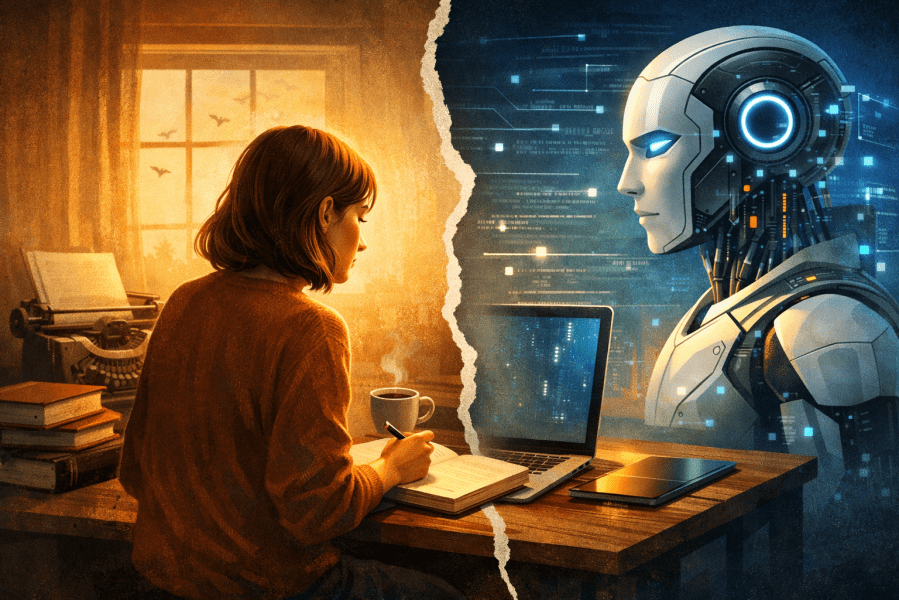
Can Technology Support a Spiritual Life?
FOR A LONG time, I assumed the answer to that question was a firm no.

If anything, technology seemed to be the antithesis of the spiritual life. The modern digital world often feels like a machine designed to fracture attention, provoke outrage and keep people endlessly, mindlessly scrolling.
I’ve long considered that it lowers the collective vibe and rewards distraction rather than reflection, generating noise rather than making space for silence.
To me, none of this seemed especially compatible with the inner life. For as we know, spiritual traditions across cultures tend to emphasise the opposite qualities:
- stillness
- patience
- contemplation
- distance from the constant chatter of the world
So the idea that technology might somehow support a spiritual practice always sounded faintly absurd.
And yet, recently, I’ve reviewed my perceptions.
I’ve done so not because the digital world has suddenly become calmer or wiser. It hasn’t. But because I’ve begun to realise something rather obvious; something I had previously overlooked. And it is this:
Technology, like most tools humans create, is morally neutral.
It doesn’t possess intentions of its own. Its value depends largely on how it’s used.

For example: a hammer can build a house or break a window. A knife can prepare a meal or cause harm. The tool itself isn’t the determining factor.
Surely, the same may be true of technology.

Choosing the Right Tool
WHEN PEOPLE TALK about technology damaging our attention, they’re not entirely wrong. Many digital platforms are deliberately designed to capture and hold attention for as long as possible.
Their design borrows heavily from the psychology used in casino slot machines. Each swipe, scroll, or click reveals something new—perhaps interesting, perhaps trivial—but always uncertain.

The endless feed creates a loop of curiosity, reward, and repetition that can hold our attention far longer than we intended.
But that doesn’t mean every technological tool works that way.
Some are simply … tools.

Take journaling, for example. Many people (such as myself) find reflective writing helpful for processing thoughts and emotions. Traditionally this meant pen and paper, and that still works perfectly well. It’s the method I — an old-fashioned diehard — prefer to use.

But it’s equally possible to write reflections in a digital document, a notes app, or a simple blog draft.
Just because the medium changes doesn’t mean the reflective process is any less purposeful.
Used with intention, I’m sure that technology can actually support practices that deepen reflection rather than scatter it.
Thinking Partner
ONE EXAMPLE THAT has recently shifted my own perspective is the emergence of conversational AI tools. Please check out my March 5 post, ‘Artificial Intelligence—Human Anxiety‘ for more on this.
Like many people, I initially approached AI tools with a liberal amount of scepticism. It wasn’t hard to imagine the ways such technology might be misused — misinformation, manipulation, or simply another digital distraction competing for attention.
And those risks remain very real.
But what I hadn’t anticipated was how such tools might also function as a structured thinking partner.
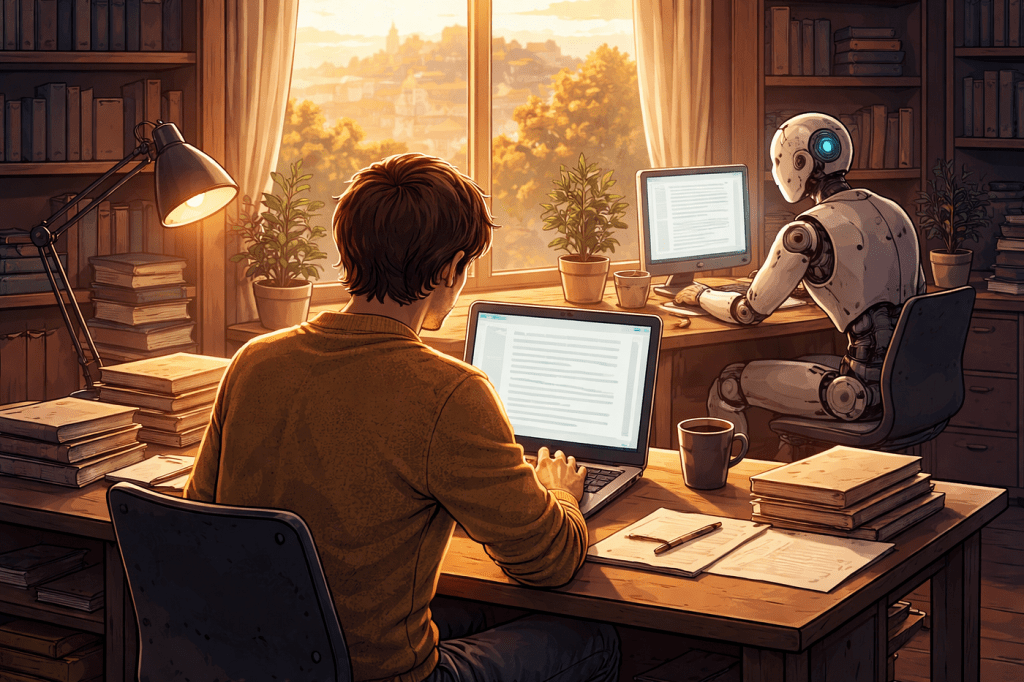
When the mind becomes tangled in its own thoughts, questions loop around without resolution. Concerns grow larger simply because they remain unexamined.
Writing those thoughts down — even in a digital conversation — can bring a surprising amount of clarity.
Not because a machine is offering profound wisdom, but because the act of articulating the question forces the mind to slow down and organise itself.
In that sense, the technology begins to resemble something quite old-school.
A reflective notebook. One that occasionally talks back.
Intention Changes Everything
THE REAL DIFFERENCE lies in how modern tools are approached.
If technology is used purely for distraction, it will almost certainly deliver distraction. As I’ve explained, endless feeds and notifications make that very easy.
But if it’s used deliberately as part of a reflective practice, the experience changes.
For example:
Someone might begin their morning by writing a few thoughts about the day ahead.
Another might use a digital prompt to guide evening reflection: What went well today? What did I learn? What deserves gratitude?
Some people use symbolic tools — tarot cards, for instance — as prompts for journaling or meditation. The purpose isn’t prediction, but reflection.
This is a subject I aim to return to in a future post.

In each case, the technology involved is secondary.
The key element is intentional attention.
Ancient & Modern
INTERESTINGLY, MANY ANCIENT spiritual traditions were never particularly hostile to tools themselves. What they cautioned against was mindlessness.


A monk copying manuscripts in a medieval scriptorium was using the most advanced information technology available in his day.
A pilgrim carrying a compass across unfamiliar landscapes relied on a piece of technology that helped guide their journey.

Tools have always accompanied human reflection.
What matters is whether the tool serves the practice, or whether the practice becomes secondary to the tool.
Space for Thought
PERHAPS THE MOST valuable thing technology can offer, when used carefully, is something quite simple.
A space to think.

In a world that increasingly encourages quick reactions and constant engagement, even a small pocket of reflective conversation or writing can feel surprisingly restorative.
It allows the mind to step back from its own noise for a moment. To examine thoughts rather than simply inhabit them. To consider possibilities rather than immediately reacting to them.
In that sense, the role of technology here isn’t to provide answers.
It’s simply to support the process of asking better questions.
For those of us who are instinctively wary of modern technology — and I still count myself among that group — it may be worth holding onto a small measure of curiosity.
Not every digital tool deserves our attention. Some probably deserve far less of it.
But others might prove unexpectedly useful when approached with care.
The key may lie in remembering that technology, like any other tool, ultimately reflects the intentions of the person using it.
Used carelessly, it can certainly scatter the mind.
Used thoughtfully, it might occasionally help us gather it again.

 RAVEN MOON