
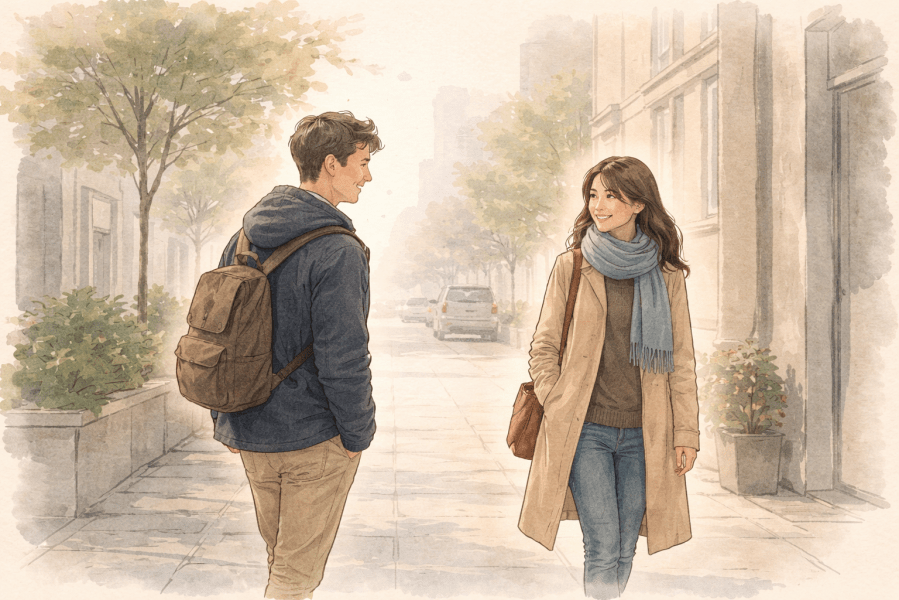
Why Saying “Hi” Still Matters
THERE IS something almost quaint about the idea of greeting a stranger. A brief ‘hello’ exchanged on a pavement, a nod to a passing walker, a smile offered without expectation.
In an age of constant purported connectivity, such moments can feel oddly subversive—small acts of recognition that dissolve detachment and diffuse distraction.
Yet these gestures matter more than we may realise. Saying ‘hi’ is not merely politeness. It is a social signal, an emotional nudge, and a reminder that we are not alone among shadows.
The Power of Being Seen

WHEN SOMEONE greets us, something subtle but profound happens: we are acknowledged. For a moment, we are not just another face in the crowd, but a person worthy of recognition.
That’s worth repeating: we are shown to be worthy.
Psychologists―who have labels for everything―often describe this as social validation. Even the briefest interaction tells the nervous system, I am safe here. I belong.
In evolutionary terms, humans survived by being noticed and accepted within a group. Moreover, to be unseen was to be vulnerable.
A friendly greeting activates this ancient reassurance. It can lift mood, reduce stress, and momentarily dissolve the sense of isolation that so often accompanies modern life—particularly in urban environments where we brush past hundreds of people without ever meeting them.
Value in a Smile
ADD A SMILE to that greeting and the effect deepens.

Smiling is contagious. Neuroscience suggests that mirror neurons prompt us to reflect the expressions we see in others. When someone smiles at us, our own facial muscles are subtly invited to do the same—even if we are not conscious of it.
And smiling back is not just a courtesy. It feeds back into our emotional state. Studies consistently show that smiling, even when initiated deliberately, can lower stress hormones, release endorphins, and improve mood. It cannot be denied: the body often leads the mind.
In this way, a smile exchanged between strangers becomes a tiny, shared act of harmonisation. Two nervous systems briefly align, settle, and move on—each a little lighter than before.
Ripple Effect
THIS IS where it gets radical.
One greeting rarely exists in isolation. It sets a tone.
Someone who has been met with warmth is more likely to offer it onward: to the next person in the queue, the colleague they pass in the corridor, the neighbour they might otherwise avoid.
Social cohesion does not usually arise from grand gestures or formal initiatives. It grows from these small, unremarkable moments repeated daily.
Communities where people acknowledge one another tend to feel safer, even when they are not statistically so. Trust begins not with intimacy, but with recognition. A society in which no one says ‘hello’ is not necessarily hostile—but it is brittle.
Urban Silence and Rural Sociability

MUCH IS made of the difference between rural and urban sociability, and between north and south. In villages, it is often said, everyone greets everyone else. In cities, eye contact is avoided, and paradoxically, headphones are donned and yet silence reigns.
This difference is not purely anecdotal. Population density changes behaviour. In cities, the sheer number of people we encounter would make constant engagement overwhelming.
As an avoidance mechanism, urban dwellers develop what sociologist Georg Simmel described as a protective indifference: a way of preserving mental energy by filtering out others.
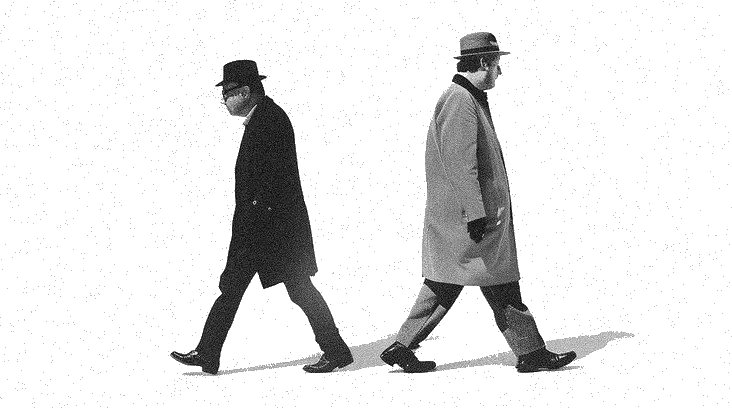
Rural settings, by contrast, offer fewer encounters, making each one more meaningful. A greeting there is not a drain on attention, but an affirmation of shared space and mutual familiarity.
North–South Divide: Myth or Reality?
THE IDEA that people in the north are friendlier than those in the south is often dismissed as stereotype, yet it persists for a reason.
Historically, northern communities were shaped by industrial labour, close-knit working-class neighbourhoods, and shared hardship. Sociability was not optional—it was survival. Mutual recognition and informal support networks became cultural norms.
In the south, particularly in areas shaped by commerce, migration, and higher population turnover, social bonds have often been looser and more transactional. Privacy and reserve became adaptive strategies rather than signs of coldness.
None of this makes one ‘better’ than the other. But it does explain why a greeting in one context feels natural, and in another feels intrusive or even suspicious.
The Risk of Saying ‘Hi‘
IT WOULD be dishonest to ignore that greeting strangers carries a small emotional risk. We may be ignored. We may be met with blankness or distrust. In rare cases, friendliness is misread.
Yet the cost of these moments is low, while the potential benefit—connection, warmth, humanisation—is high. Importantly, the intention behind a greeting matters. A simple, unassuming ‘hello’ offered without demand respects boundaries while leaving the door open.
We are not obligated to perform friendliness, nor should we expect it in return. But offering it freely, without attachment, is one of the gentlest ways we participate in the social fabric.
Relearning a Forgotten Skill
Saying ‘hi’ is not about nostalgia for a lost golden age. It is about remembering a skill that technology has not replaced―nor ever will: acknowledging the presence of another human being.
In a world increasingly mediated by screens, algorithms, and anonymity, these micro-interactions ground us. They remind us that society is more than a notion—it is built moment by moment, face to face.

A greeting does not change the world. But it can change a moment. And it is accumulated moments that shape how it feels to live among others.
Sometimes, the most radical thing we can do is look up, meet a stranger’s eyes, and say:
‘Hello.’
 RAVEN MOON