
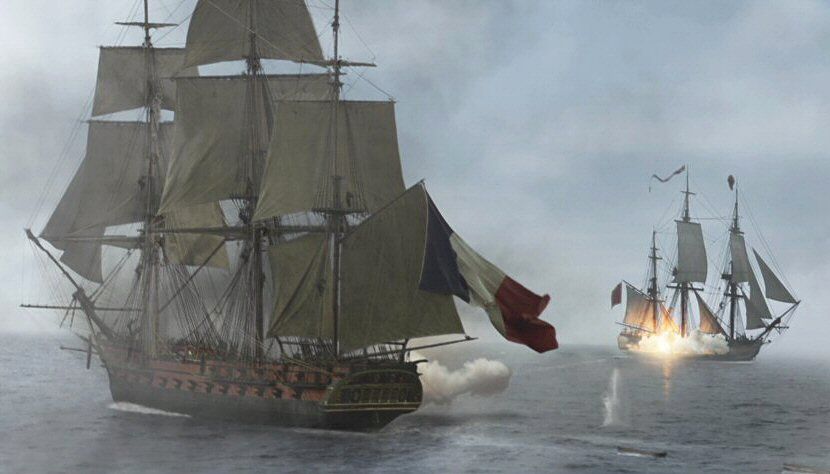
Why Master & Commander Still Rules the Screens
THERE ARE SOME movies you watch once, enjoy, and then forget. And then there are movies like Master and Commander: The Far Side of the World (2003)—films that stick with you. Films that quietly work their way into your imagination and refuse to leave.

Directed by Peter Weir and starring Russell Crowe and Paul Bettany, Master & Commander is not just a naval adventure. It’s history, art, music, friendship, and a reflexion on what it means to lead—all rolled into one.

History That Feels Real
ONE OF THE things that makes Master and Commander stand out is its historical authenticity. Everything about HMS Surprise feels lived in—cramped hammocks swinging on the gun deck, the constant creak of wood and rigging, the thundering cannons.

‘I am passionate about Napoleonic era Naval History and that’s why one of my favourite movies in the world is ‘Master and Commander – The Far Side of the World‘ with Russell Crow.’
Historian Dan Snow
The filmmakers went all-in on period detail, even down to how the sailors spoke and how they repaired sails. This isn’t Hollywood’s glossy puerile glitz—it’s sweaty, salty, breathtakingly-beautiful and often intense.
Watch it, with lights turned down and sound tweaked up a notch and I swear you’ll almost feel the salt spray on your face.

A Vast Canvas
VISUALLY, THE film is stunning. So many shots look like they could hang in a gallery. A mid-battle tableau lit like a Caravaggio. A ship ghosting out of the fog like a Turner seascape. Or a sunset on calm seas that could pass for a Constable.

(Left) Seascape by John Constable
(Right) The Death of Nelson by Arthur William Devis
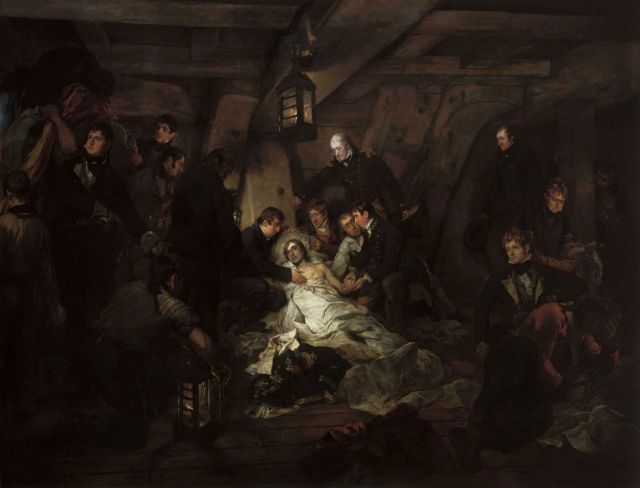
The decision to shoot with natural light—lanterns below deck, dawn and dusk on the horizon—makes it feel timeless. You don’t feel like you’re watching a film so much as stepping into a painting that moves and breathes.

Choosing the Lesser Evil
AT ITS CORE, though, Master and Commander isn’t just about ships and cannons—it’s about difficult choices. Captain Jack Aubrey (Russell Crowe) is constantly forced into impossible situations.
Every decision—whether to chase an enemy, risk his ship, or discipline a crewmate—comes down to picking the lesser of two evils. This central theme, which runs through the movie, less like a thread and more of an anchor cable, is introduced early in a scene which sparkles with humour.
The easy banter with which the film’s essence is delivered juxtaposes its gravity. There are no easy choices, no perfect answers and no outright wins. And that’s what makes it feel real.

Through Crowe, Captain Aubrey shows us that leadership isn’t about being heroic all the time; it’s about carrying the heavy burden of tough choices and living with the consequences.
This theme plays out most powerfully in Aubrey’s friendship with naturalist, Dr. Stephen Maturin (Paul Bettany). Their relationship is the film’s beating heart—warm, witty, sometimes argumentative, but always respectful.
They’re a captain and his surgeon, but also friends who take time out to play violin and cello together in the quiet between storms.

Those music scenes are magical: two men finding beauty in the middle of chaos.
Music That Lingers
SPEAKING OF MUSIC—the soundtrack is incredible. A mix of period-appropriate pieces and original compositions imparts both energy and intimacy.
When Crowe and Bettany sit down to play, it’s not just a character moment, it’s a reminder of why culture matters—why beauty matters—even in the darkest times.
Powerful Performances
RUSSELL CROWE gives one of his best performances as ‘Lucky Jack’ Aubrey. He’s bold, charming, and at times infuriating—exactly what you’d expect from a real captain.

Paul Bettany balances him perfectly, playing Maturin as thoughtful, compassionate, and scientifically curious. Together, they create one of the most believable on-screen friendships in any historical film.
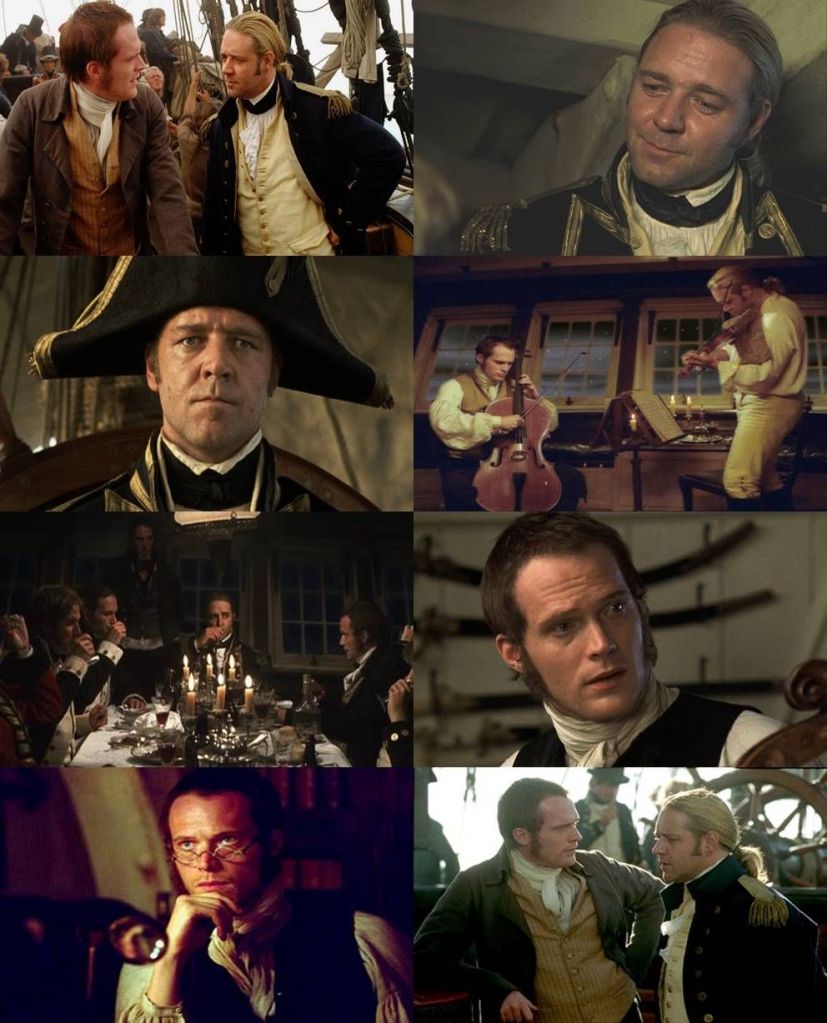
The supporting cast—many of them unknowns—only adds to the sense of authenticity.
Here I’ve simply got to acknowledge a stunning performance by Max Pirkis, then only fourteen years old, who played the young midshipman Blakeney. For such a young actor, his performance is astonishing.
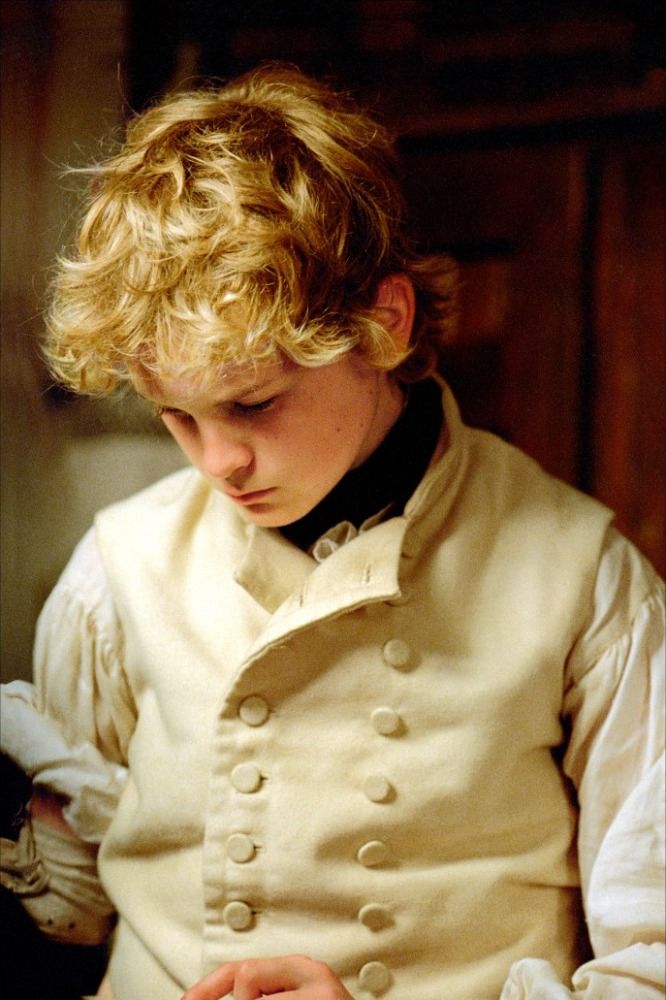
In the opening battle he’s badly injured and ends up losing an arm. The way Pirkis handles those scenes – including surgery without anaesthetic in a cramped, dimly lit cabin – is unforgettable, heart-breaking and inspirational.

He plays Blakeney with a scene-stealing mix of fear, courage, and stubborn pride that feels completely genuine.
In him, you see a remarkable boy who’s grown up fast, far from home, because he has no choice.
His moments with Paul Bettany’s Dr. Maturin are especially powerful, and for one so young, his performance is unforgettable.

And then there’s one of my favourite actors, Lee Ingleby, as Midshipman Hollom, an insecure officer who just can’t seem to find his footing.

It’s a tough role, because Hollom isn’t heroic or especially likable—he’s hesitant, unsure, and painfully aware that he doesn’t command the respect of the crew. But Ingleby plays him with such honesty that you can’t help but feel for him.
His uncertainty and insecurity is evidenced early on. Having seen what he considers may be another vessel in a fog bank, he is unable to give the order to ‘beat to quarters,’ by which the ship’s compliment is brought to action stations.
His story adds a raw, tragic layer to the film, showing how unforgiving life at sea could be for a young man who wasn’t cut out for it. It’s one of those performances that quietly lingers with you long after the battle din and cannon smoke recedes and the screen fades to black.

Enduring Quality
FOR ME, WHAT makes Master and Commander so special is that it doesn’t just tell a story—it creates a world. You don’t watch it so much as live in it for two hours.
It’s as much about friendship, art, and leadership as it is about naval battles. It’s as beautiful as a Turner painting and as tense as a gun crew waiting for the word to ‘fire!’

And honestly? In an era dominated by noisy, CGI-filled blockbusters and endless sequels, this film is no less than a breath of fresh salt-sea air. It’s proof that, with the right people behind it, you can make something thrilling and thoughtful at the same time.
So if you haven’t watched it in a while—or ever—do yourself a favour. Set aside an evening, dim the lights, and let Master and Commander take you to sea. Just don’t be surprised if you come away humming a tune and mulling over the impossible choices that come with command.

 RAVEN MOON