A Post COVID-19 Autopsy
They will feel like they are drowning in information, but they will think they are intelligent.’ – Ray Bradbury
IN EARLY 2020, the word pandemic became an everyday term — repeated in headlines, political speeches, and on endless, real-time news feeds. The world was told a deadly, once-in-a-century virus had arrived, one which required unprecedented action.
Emergency powers were invoked. Entire economies were put on hold. Civil liberties were suspended—all in the name of ‘public health.’
And yet …
… five years on, we are left with a puzzling reality.
For something billed as a catastrophic pandemic, all-cause mortality barely shifted beyond historical norms. Meanwhile, deaths from long-standing killers — heart attacks, strokes, diabetes, and seasonal flu — mysteriously plummeted.
Were we witnessing an unparalleled viral threat, or simply a dramatic rebadging of death?
Something doesn’t add up — and pretending it does only fuels the growing distrust many now feel toward institutions, including our own NHS, that claimed to be ‘following the science.’
When Is a Pandemic Not a Pandemic?
LET’S STEP BACK. A true pandemic, by any reasonable measure, should cause widespread excess death. We should have seen cemeteries overflowing across age groups and demographics. We didn’t. What we saw, instead, was a statistical shuffleboard.
COVID was listed as the cause of death in extraordinary numbers — often based on assumption rather than verification. At the same time, long-established causes of death dropped off the radar.
Did strokes, cancers, and respiratory diseases suddenly take a holiday? Or were those deaths simply rebranded under a single, politically-charged label: COVID-19?
The incentives to do so were clear. Hospitals were paid differently. Media thrived on a feeding frenzy of sensationalism. Governments could justify sweeping control measures.
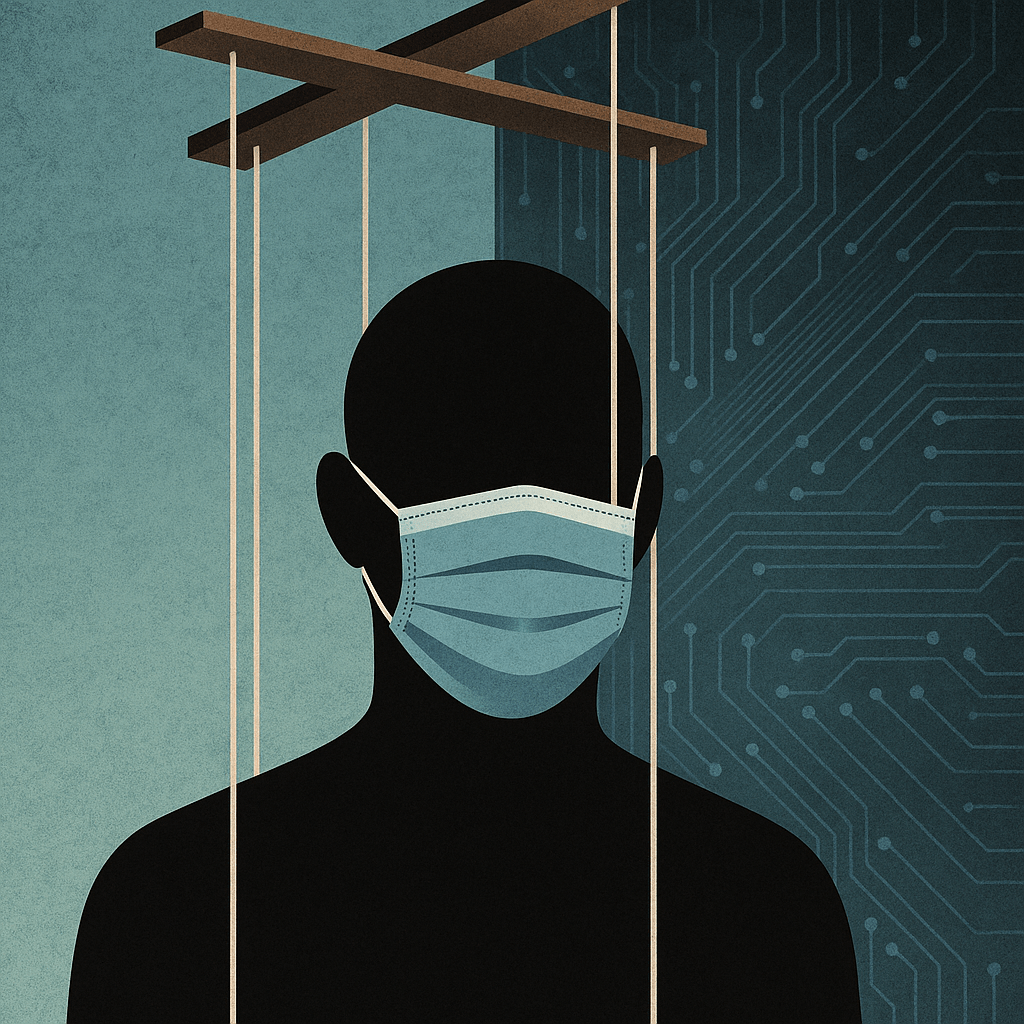
Fear, we learned, is an exceptional compliance tool.

The Theatre of Public Health
MASK MANDATES, lockdowns, curfews, plastic barriers, one-way supermarket aisles — all became part of the new hygiene theatre. These initiatives were not simply ineffective they were counterproductive. Yet questioning these ridiculous histrionics at the time was taboo.

Scientific debate was replaced by political dogma. Studies that contradicted the narrative were buried. Experts who challenged the orthodoxy were silenced, smeared, or de-platformed. ‘Trust the science’ quickly became a euphemism for ‘obey.’
Meanwhile, the psychological toll was immense.
Children were masked and isolated, their education disrupted. The elderly died alone. Small businesses collapsed while mega-corporations thrived and their profits soared.
Society, intimidated and bullied into submission, capitulated. And it did so compliantly, and on command.
‘There will be in the next generation or so a pharmacological method of making people love their servitude and producing dictatorship without tears, so to speak.
Producing a kind of painless concentration camp for entire societies so that people will in fact have their liberties taken away from them, but will rather enjoy it, because they will be distracted away from any desire to rebel – by propaganda, or brainwashing, or brainwashing enhanced by pharmacological methods. And this seems to be the final revolution.’
Aldous Huxley, 1961
Experimental ‘Vaccines’ & Moving Goalposts
WHEN THE so-called vaccines arrived, they were sold as the ticket out of crisis. ‘Get the jab and get your life back,’ we were told. But life didn’t return to normal. Not even close.
Unsurprisingly, the experimental injections (no human trials had been conducted) didn’t stop infection. They didn’t stop transmission. ‘Fully vaccinated’ morphed into ‘double-boosted’ and beyond. And still, cases surged.
Yet few seemed willing to ask: If the shot doesn’t prevent catching or spreading a so-called virus, in what sense is it a vaccine?

Those who hesitated were ostracised, and in some cases legally excluded from their place of work, or from public life. In a civilised society, this alone should have sparked outrage. But fear had done its work.
People accepted discrimination in the name of ‘safety.’ The long-term consequences of this societal experiment remain unknown — medically, socially, and ethically.
A Society Transformed — But Why?
TODAY, AS WE trudge through a post-COVID landscape, the most haunting question is not what happened — but why.
Why were whole populations so quickly corralled into submission? Why were liberties abandoned without resistance? Why was dissent criminalized?

The answer may well lie beyond medicine.
The pandemic created the ideal conditions for something unprecedented: A global reset.
Around the world, financial systems teetering on the brink were given breathing room. Technological surveillance accelerated. Supply chains were reshaped. Central banks printed eye-watering sums of money with minimal scrutiny. Take the UK for example:
Asset purchase facility:
- Early 2020: £435 billion
- Dec 2021: £895 billion
- More than doubled.
Source: Bank of England Statistics
Populations, meanwhile, bullied into submission or pacified by fear and media saturation asked few questions.
All this was achieved under the perfect cover of a health crisis.
The result? A society where working from home is normalised, isolation, depression and mental health issues have skyrocketed, physical cash is on its way out, biometric surveillance is accepted, and obedience is a civic virtue.
What began as a response to a virus evolved into a wholesale transformation of public life.
Engineered? Or Just Convenient?
IT’S EASY TO jump to conclusions. But we must at least consider the possibility:
Was COVID-19 leveraged, if not orchestrated, as a catalyst for change?
The term Great Reset was not invented by internet commentators. Nor was it the language of ‘conspiracy theorists.’ It was coined and promoted by unelected, global institutions like the World Economic Forum.
Their vision? A reimagined world order: digitised, centralised, and tightly controlled.
Conveniently, COVID turned that ambitious vision into a reality.

People who once valued freedom began demanding control. People who distrusted governments became informants. Under the guise of protecting the vulnerable, whole societies handed over liberty, personal sovereignty and bodily autonomy with barely a murmur.
So where are we now?
- Social cohesion has collapsed. Families divided over medical choices. Communities splintered along ideological lines.
- Civic freedoms were suspended — and have not fully returned.
- Public trust in institutions is near historic lows.
- Economic disparity has widened dramatically. Billionaires got richer; workers got poorer.
- Health is worse, not better — mental illness, excess non-COVID deaths, and chronic illness are all rising.
And yet, few leaders speak of this damage. There’s no reckoning. No apology. Just silence.
Conclusion: Not Just a Virus, but a Test
Whether or not COVID-19 was manufactured or manipulated, it served as a stress test for society — and society failed it. Monumentally.
It failed because the vast majority abandoned common sense and discernment. Scientific rigor was replaced with slogans. Fear overrode reason.
More unsettling is the realisation that much of what was lost — privacy, freedom, trust — may never return. Not because of a virus, but because vast swathes of a compliant population accepted their removal as temporary … never demanded otherwise and continue to suffer in silence.
So was it really a pandemic — or something else entirely? A managed event. A reset. A test of obedience on a global scale.
That’s not a conspiracy theory. That’s a question.
‘Various types of belief can be implanted in many people after brain function has been deliberately disturbed or deliberately induced fear, anger or excitement. Of the results caused by such disturbances, the most common one is temporarily impaired judgement and heightened suggestibility.
Its various group manifestations are sometimes classed under the heading of ‘herd instinct’, and appear most spectacularly in wartime, during severe epidemics, and in all similar periods of common danger, which increase anxiety and so individual and mass suggestibility.’
Psychiatrist & Tavistock Institute member, Dr William Sargant – ‘Battle for the Mind’ 1957
 RAVEN MOON