

My formative years coincided with the 1970s – no doubt the weirdest decade in human history. The nation’s economy was crumbling. We had blackouts, uncollected trash and silent factories – yet, for all that, we managed to finance and propel Concord into the skies of an indifferent world.

In 1977 we had the monarch’s Silver Jubilee, a pageant of imperial nostalgia, while at the same time, across the airwaves the Sex Pistols screamed ‘God Save the Queen!’
Meanwhile, children’s TV was psychedelic and haunting. We had ‘The Clangers,’ ‘Bagpuss’ and ‘The Tomorrow People’ – gentle viewing, perhaps, but laced with melancholy and unease.
In fact, 1970s Britain seemed to be lost in a twilight zone of contradictions and inconsistencies, unsure of its identity or direction. Imagine a punk band playing in a ballroom of rising damp and peeling wallpaper and you have it; wildly imaginative yet falling apart at the seams.
The result was a cultural and political dreamscape—a fertile ground for revolution, reinvention and the bizarre. Little wonder then that it was at this time I developed a thing for surrealist art – and in particular the amazingly vigorous works of Salvador Dali.
Blu-tacked to my bedroom wall during my late teens were several art prints purchased during visits to London’s Tate Gallery. Of these, perhaps the most remarkable was Dalí’s ‘Metamorphosis of Narcissus.’

I WASN’T ENTIRELY sure what it meant, and to be honest, I never gave its meaning much thought. But something about it grabbed me—its eerie beauty, its doubled forms, the unsettling way it looked so real and yet so dreamlike at the same time.
It was the kind of image that made you feel like there was a secret encoded message hidden within the brush strokes. Now, years later, I’ve decided to consider what that message may have been—not as a teenager trying to impress my art teacher, but as an adult still fascinated by this captivating work of art.
It seems that Dalí based the painting on the Greek myth of Narcissus: the beautiful youth who fell in love with his own reflection and ultimately turned into a flower. It’s a classic story of vanity, ego, and transformation. But there’s so much more going on here. Of course there is. This is Dalí, after all.
On one side of the canvas, there’s a crouching figure staring into a pool—Narcissus himself, presumably. On the other side? We have a stone-like hand holding an egg, from which sprouts a narcissus flower. The hand and the figure mirror each other exactly. The very moment of transformation has been frozen in time. Narcissus becomes statue, becomes flower, becomes … what, exactly?
That’s part of the mystery.
THE MORE YOU look, the more the painting unfolds, the more it reveals. That egg with the flower growing from it is surely a symbol of rebirth. But what of the ants crawling up the hand? Well, we know that Dalí had a fear of ants. So much so that he would use them in his art, where they often stood for decay or death. So even in this snapshot of rebirth, there’s something uncomfortable gnawing at the edges.
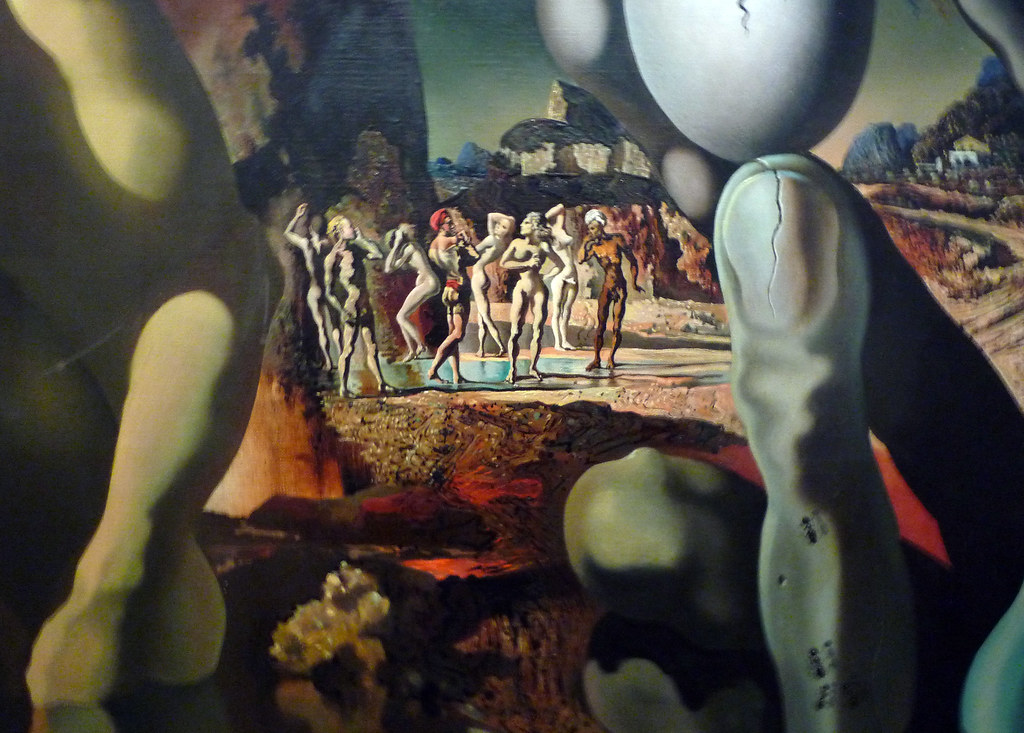
In the background, slightly out of focus, weird little figures strut by a pool in a barren landscape, and there’s even a chessboard in the middle of nowhere (because why not). Every element feels chosen, loaded, just opaque enough to make you want to stare longer, unravel the mystery, crack the code.
Looking back, I feel sure that it was the fabulous colours that first drew me into this piece. Here we have photorealism, colour-washed with riddles. It’s surprisingly naturalistic—browns, blues, muted skin tones—but the effect is totally … well, surreal. That’s part of Dalí’s genius. He paints dreamlike imagery in such a precise, almost photographic style that it feels more real than reality itself.
It’s like a psychedelic head-trip you can touch and feel.

Dalí didn’t just paint this work—he wrote a poem to go with it – a stream-of-consciousness piece that talks about death, transformation, ego, and love. All very Dalí. As an artist, he was obsessed with what he called the paranoiac-critical method—by which he applied ‘controlled madness’ to unlock creative potential.
So that’s what this painting is: a mirror turned inside out, a myth seen through the lens of psychological breakdown.
“Narcissus, in his immobility, begins to crumble. At the peak of his death, he is transformed into a flower.”
Dalí, 1937
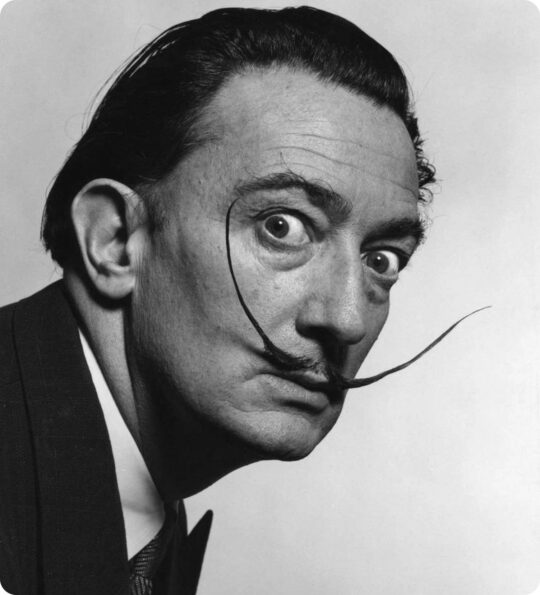
WHEN Metamorphosis of Narcissus was first exhibited in London in 1937, critics were deeply impressed. Even those who weren’t fully sold on surrealism had to admit—this was something special. Dalí’s technical skill was undeniable, and his imagination was unique.
Coming back to this painting now, I totally get why my younger self was so mesmerised. It’s about identity, transformation, obsession—all the stuff that feels especially loud when you’re a teenager, but which, for me, has increased in volume in recent years. But also, it’s just strange in the best possible way.
‘Metamorphosis of Narcissus’ doesn’t hand you easy answers. It invites you to stare, to think, and maybe even get a little lost. And honestly, in a world that often demands instant clarity, there’s something kind of cool about a painting that just occupies its piece of wall-space, calmly refusing to explain itself.
‘If one looks for some time, from a slight distance and with a certain ‘distant fixedness’, at the hypnotically immobile figure of Narcissus, it gradually disappears until at last it is completely invisible.’
Dalí, 1937
 RAVEN MOON