
I was ten years of age in 1968.
Coincidentally, so too was Rob Blaine of Idaho, USA – but I’ll come back to him later.
Like many youngsters growing up in the 60s, the keeping of a scrapbook was one of my hobbies. Unlike this blog, however, the content of which could be described as a ‘pot pourri’ of disconnected subjects, my scrapbook’s content followed a specific theme. It was a theme influenced by events of that time – the war in Vietnam.
For me as a ten year old, the lines between fantasy and brutal reality were fuzzy. And like many boys my age, I watched war on TV in programmes such as ‘Combat‘ and ‘Hogan’s Heroes.’ I played wargames with friends and also regarded my many toy soldiers as my favourite playthings.
Consequently, the press’s daily presentation of graphic images depicting the conflict in Vietnam captivated rather than appalled me. I can’t remember the criteria I used, by which some articles were chosen whilst others were disregarded, but once my parents had finished with the daily newspaper, those items selected would be carefully snipped out and glued into place.
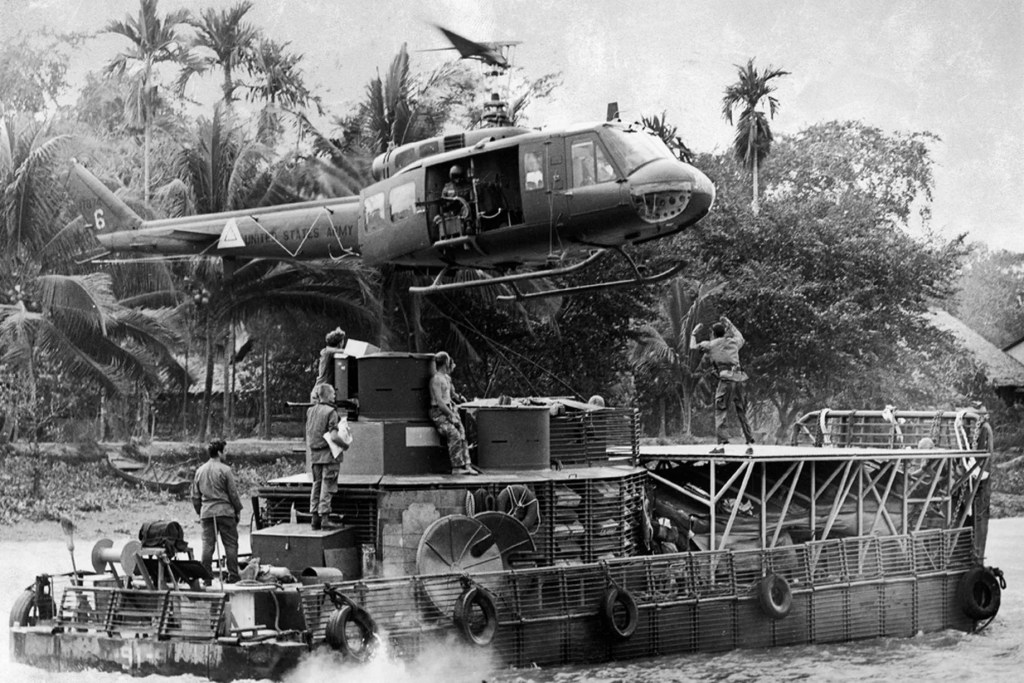
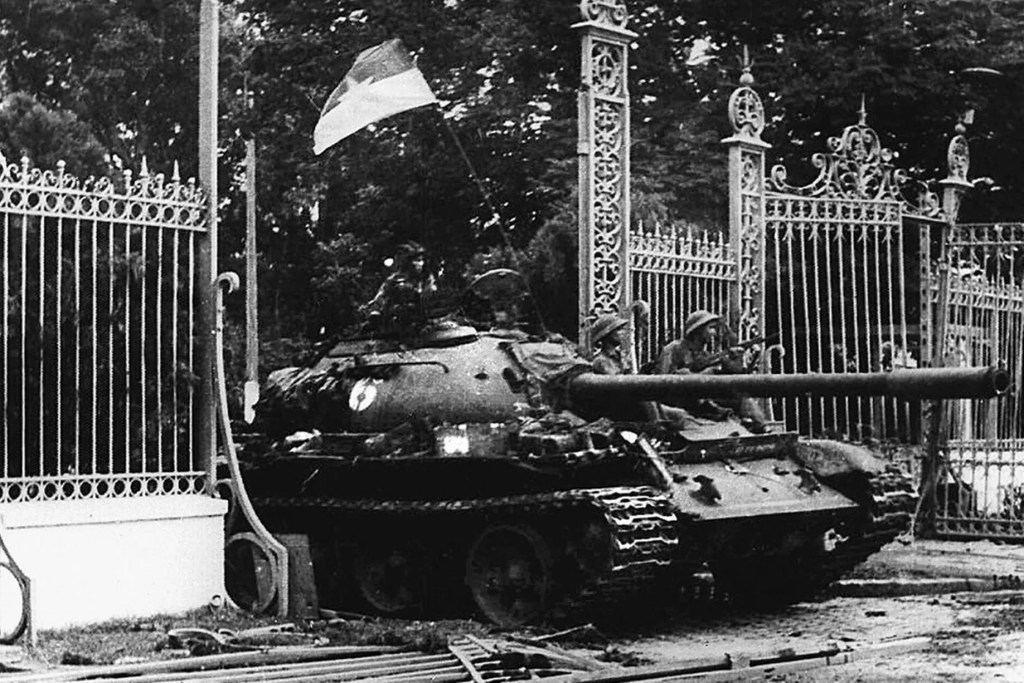


The conflict between North and South Vietnam spanned nineteen years, of which the US’s involvement ran (officially) from 1964 to 1975. In that time, several images which appeared in the global media aroused such intense feelings that they have since become icons for the era.
Among the most shocking images are Nick Ut’s ‘Napalm Girl’ and Eddie Adams’ ‘Saigon Execution,’ both of which became synonymous with the US people’s widespread outrage and disapproval of the war.
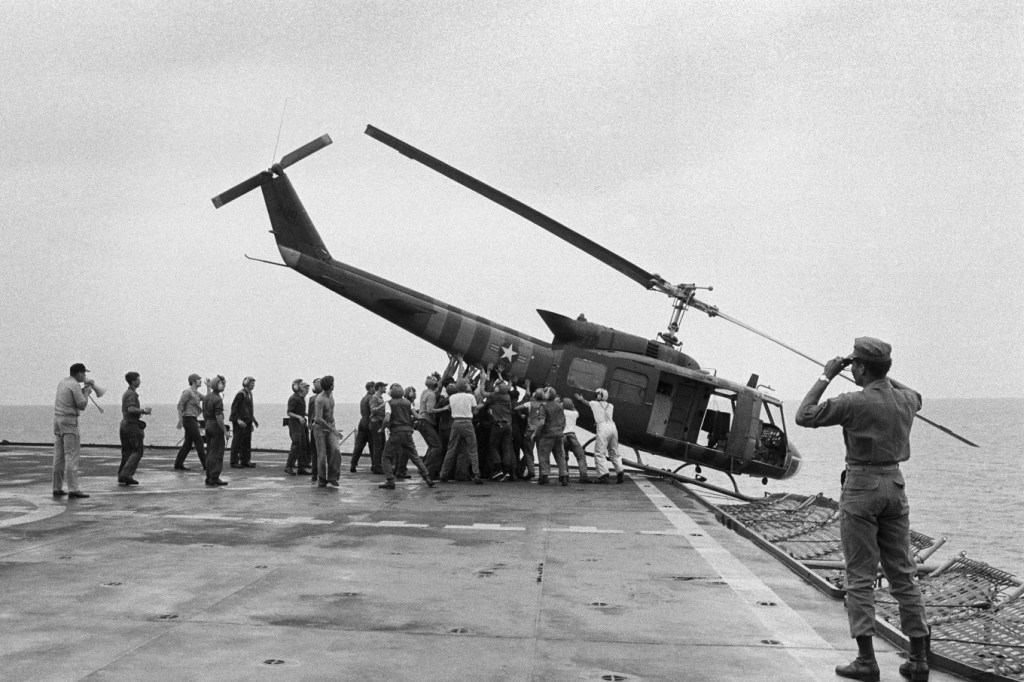
Some pictures, however, simply characterised the tragic absurdity of an event which, journalist John Pilger described as ‘A Dirty Little War’ in his powerful front-page despatch of April 30, 1975.

(Left) As enemy forces converge on the city, a U.S. Marine helicopter takes off from helipad on top of the American Embassy in Saigon, Vietnam, April 30, 1975
(Right) U.S. Navy personnel aboard the USS Blue Ridge push a helicopter into the sea to make room for more evacuation flights from Saigon, Tuesday, April 29, 1975.
For me, however, one image stands out as being the most emotive of them all. While all the others were forgotten, one retained razor-sharp clarity.
It was fifty nine years ago that I cut the unforgettable image from my dad’s newspaper and added it to my collection. Yet, for all the time that has elapsed since then, I have only to close my eyes and bring it to mind and the picture materialises, as vivid in my imaginings as though it was laid before me.
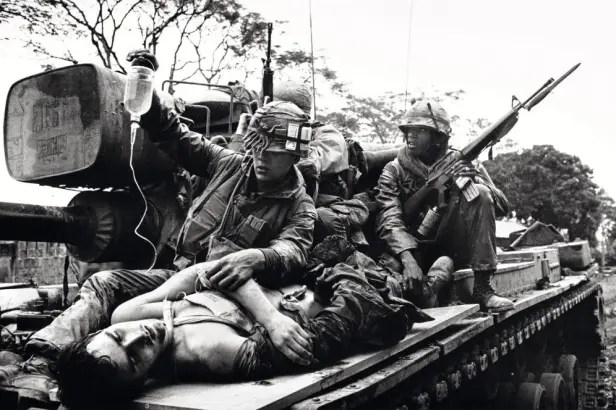
The picture is this one:

A few days ago I had occasion to recall the image to mind. This time, however, and for some inexplicable reason, I now felt moved to go a step further. My curiosity was aroused.
I typed what I hoped to be a sufficient description into my search engine, pressed ‘enter’ and the image instantly appeared on the screen – as familiar as that day in 1968 when I snipped it out of the Daily Mirror.
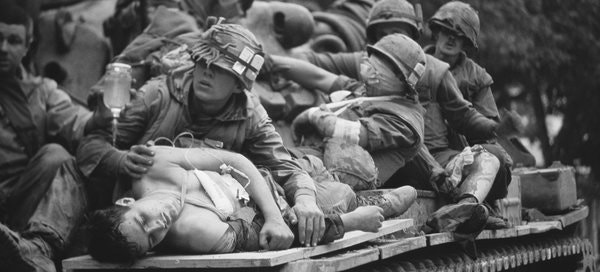
As I viewed the picture for the first time in many years – a marine, his face heavily bandaged, one with a bleeding leg, one sporting a rubber octopus in his helmet band, and another holding a plasma bottle for a further wounded marine laid out on a makeshift stretcher – I realised that now was the time for me to learn the story behind the photo.
What were the events that led to this snapshot in history? Who were the men on the tank? And as for the gravely-wounded marine in the foreground, laying on an old door with his chest heavily bandaged – what became of him?
First of all, the picture was taken by John Olson (right), then an American combat photographer working for the Stars & Stripes newspaper.
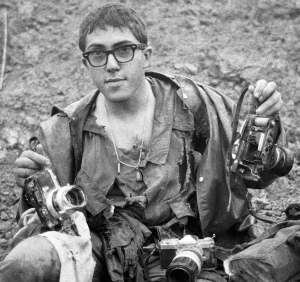
It was while following the 1st Battalion, 5th Marine Regiment that Olsen took a series of photographs of the Battle of Hue as US marines tried to take back the city. His ‘wounded marines ‘ photograph is considered one of the most emblematic images of the conflict.
Olson had been drafted in 1966 when he was 19 and was assigned as a photographer to Stars and Stripes, the official newspaper of the United States military. He carried five cameras, shooting black-and-white film for Stars and Stripes, and colour to capture images that he might sell elsewhere. The Hue photos were almost immediately published in Life and soon earned him a job as the magazine’s youngest-ever staff photographer.
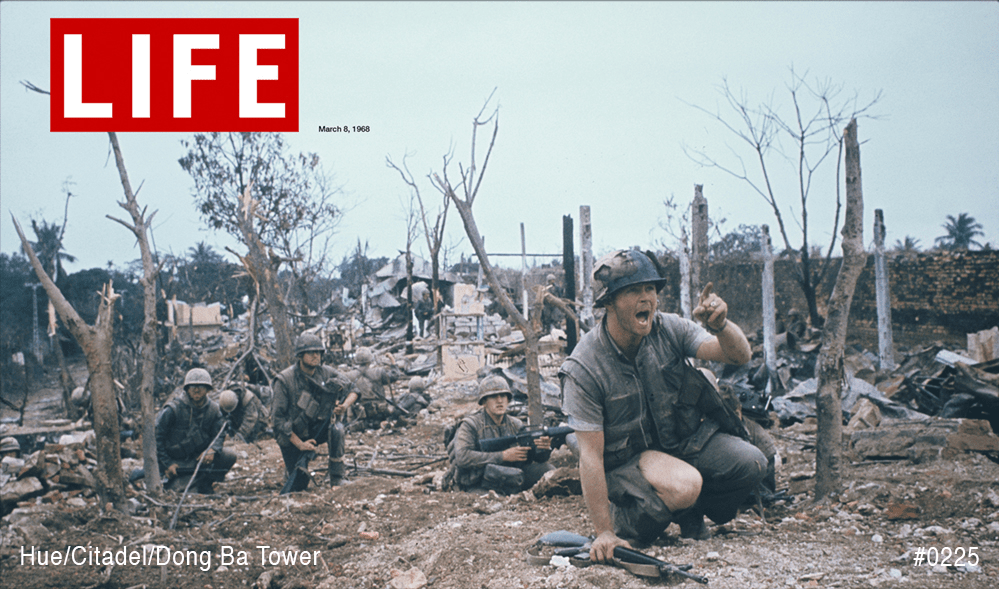
His coverage of the Battle of Hue earned Olsen the Robert Capa Gold Medal for his ‘exceptional courage and initiative’. The rawness of his images and their influence on public opinion are considered to have played a significant role in America’s subsequent withdrawal from the Vietnam War.
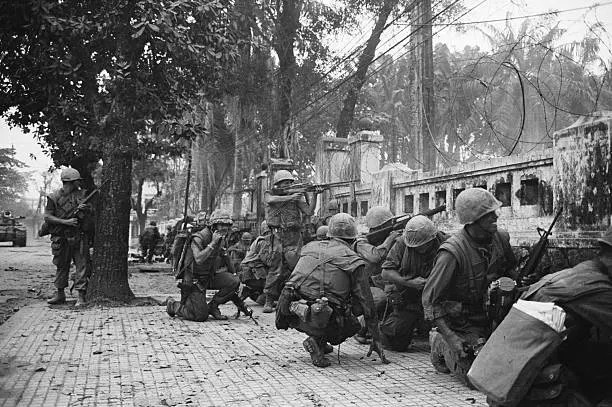
It was February, 1968, and American and South Vietnamese forces were engaged in a desperate attempt to counter the North’s surprise onslaught, since referred to as the Tet Offensive. The fighting in Hue City was as intense and chaotic as anything the Marines had experienced.
First Battalion, Fifth Marines had breached the city’s historic Citadel. Radio communications were cut, however, requiring front-line Marines to run the gauntlet of enemy fire to maintain contact with their commanding officers, relaying information and receiving orders.
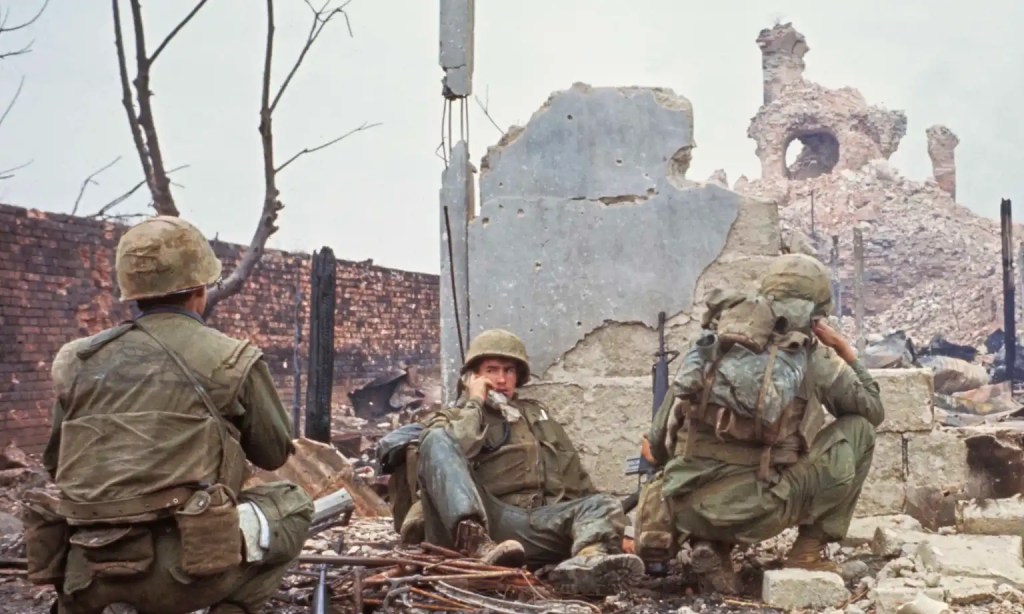
Many soldiers had already been wounded or killed. As more casualties accumulated, Marines in Charlie Company’s Third Platoon helped lift a gravely wounded and unconscious infantryman onto the front of a tank; the man was sprawled on a wooden door that served as a stretcher.
The tank then proceeded through streets littered with rubble and alive with gunfire, before stopping to pick up three further Marines who had been injured by a mortar blast. One man’s face was swathed in bandages. He was helped aboard and positioned near the tank’s back end.
It was at this point that photographer, John Olson, approached and began to document the moment. His photo of the unconscious Marine lying on the tank and surrounded by his wounded comrades now stands among the iconic images of the Vietnam War. Such was the intensity of the battle that Olsen has neither recollection of the individual men, nor taking the picture.
Nevertheless, expertly composed in the heat of the moment and visually devastating, the image was raw evidence of a hellish 26-day battle; one that contributed to turning the tide of opinion against the war.
Over the ensuing decades, Olson’s photograph was published several times, most prominently on April 1, 1985, when People magazine published it with an appeal for help in identifying those Marines on the tank.
Through readers’ replies it did not take long for the soldiers in the frame to be identified – except the unconscious Marine. From left to right those recognised were:
Jim Beals (holding IV bottle), Richard Schlagel, James Richard Rice (bandaged face), Dennis Ommert (bloody leg) and Clifford Dyes.
Following the publication of a second People article, one of their reporters managed to track down the Navy corpsman assigned to the unit who had treated the as yet undefined Marine. The corpsman, Octaive Glass, identified the wounded man as Private First Class (Pfc), James Blaine.
When details of Glass’s identification were published on June 3, 1985, an accompanying editor’s note revealed that, tragically, Blaine had died of his wounds on February 15, 1968, the day the photograph was taken.
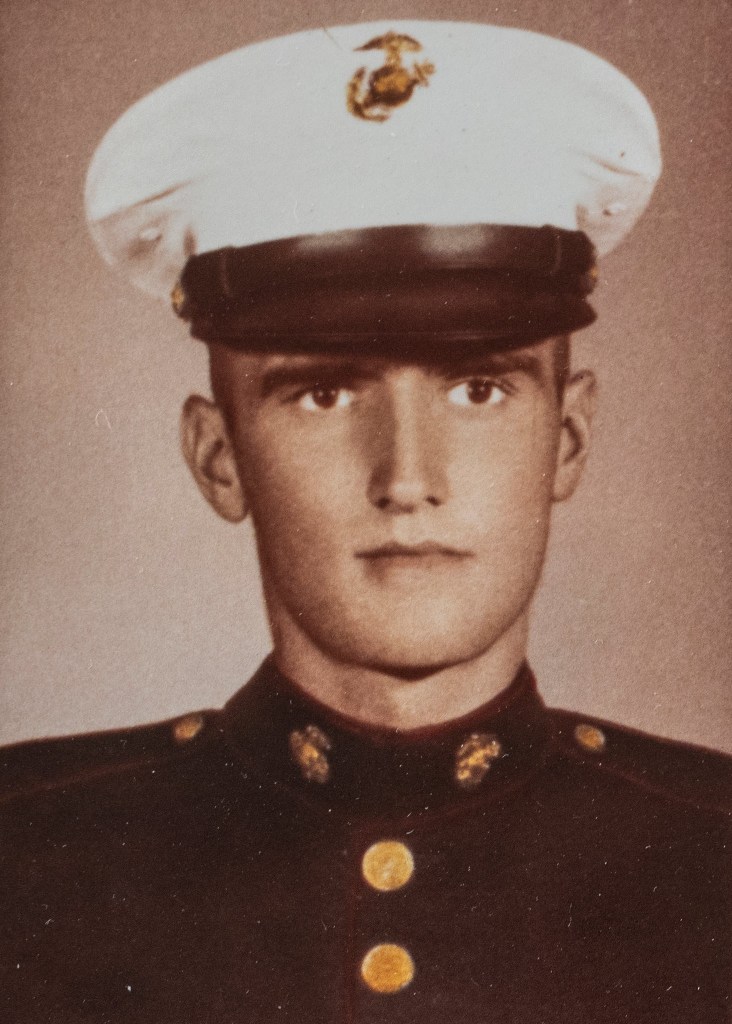
Through Glass’s testimony, the Marine now had a name. But who was James Blaine?
Blaine had been born in Moscow, Idaho, on March 22, 1949, to Jim and Ann Blaine. His father was a veterinary doctor working in meat inspection for the United States Department of Agriculture; his mother had trained as a nurse.
The second of nine children, and known by his family as ‘Jimmy,’ James was a keen athlete. He had played high school basketball and pole-vaulted on the track team before enlisting in the Marine Corps in May 1967.
His brother Rob, mentioned at the opening, now comes into the story.
Rob was ten years old when Jimmy was killed. He has since told of his older brother’s journey from active high school student to having premonitions of his own death.
‘Jimmy was a hard worker. He used to get up and move water pipes at a local fruit farm before going to school. He used to ride bareback broncos in small weekend rodeos in north Idaho and western Montana.
He was a tough kid, but kind as well. At the rodeo, an old cowpoke tried to sell Jimmy his coat to get some drinks. Jimmy gave him the $5 he asked for but wouldn’t take the coat.
Jimmy was quiet, but he had a sense of adventure. His parents tried to talk him into joining the Navy or Air Force instead of the Marine Corps, but he wanted to go where the action was.’
Rob also recalls the time Jimmy departed for Vietnam, after completing boot camp. While at the airport he’d told their other brother, Tommy:
‘ … [that] he probably wouldn’t see him again. He knew he was going to be in the fray pretty deep.’
Positive identification of the stricken Marine had been a contentious issue. Through claims made in ‘Hue 1968: A Turning Point of the American War in Vietnam,’ by Mark Bowden, the man was formerly believed to be Pfc, Alvin Grantham.
In June 2017, however, shortly after publication of Bowden’s book, the claim was challenged by Anthony Loyd, a British author and long-serving war correspondent for The Times of London.
While conducting his own research into the events of the Hue battle, Loyd had been working with the well-known British photographer, Don McCullin. In the process of his own enquiries, Loyd’s attention had shifted to the wounded Marines on the tank — a scene that McCullin had photographed just minutes before Olson.
Whereas Olson had photographed the unconscious Marine almost in passing, McCullin had been present with Third Platoon when the Marine was shot, and had photographed his initial treatment by Glass and other members of his platoon.
McCullin had witnessed and documented almost the entire sequence of events, and remembers it well.
In 30 images on two rolls of film, he followed the unconscious Marine and members of Third Platoon from the moments just after Blaine was shot until he was lifted onto the tank. This sequence, including images that show the wounded man from different angles, combined with other information to convince Loyd that the wounded Marine was Blaine.

Photo by Don McCullin
To Loyd, it was all there: clear views of Blaine’s face and the bandages indicating the location of his wounds, and the tell-tale white door that was used as a stretcher. A further decisive clue was the presence, in several of the frames, of Marine Richard Schlagel. Schlagel wore a distinctive rubber octopus tucked into his helmet band, and this was visible in several of McCullin’s photographs and also in the one shot by Olson.
(Left) Marine Richard Schagel holds IV bottle for wounded marine, James Blaine, Hue 1968
(Right) Richard Schagel today

These signature elements clearly tied McCullin’s sequence of images and the Olson photo to the same event – and to the same wounded man. Consequently, through Loyd’s meticulous research and reporting, the ‘mystery Marine,’ once believed to be another man, had at last been reliably identified as Pfc James Blaine.
Blaine could now receive just recognition for the part he played. Journalist Loyd put it this way:
‘It’s like his soul got carelessly mislaid.’
In my previous post – ‘Helvegen’ – I presented a piece of music that reminds us that death is not the end, for one’s deeds and reputation in life generate enduring stories. I believe that the above post is proof positive of that assertion.
Sometime before enlisting into the Marines in 1967, Jimmy Blaine gave five dollars to a down-and-out ranch hand. And now, by reading this brief account, you have learned not only of him and his simple act of good-hearted charity, but also of his service and sacrifice for his country.
 RAVEN MOON