Last November, in my post titled ‘Hi-bear-nation,’ I presented a music track by Norwegian group, Wardruna. I featured a further piece by them – ‘Odal‘ – in my post of that name in April this year.
Wardruna’s distinctive style is a blend of age-old Nordic sounds and traditions interwoven within a contemporary acoustic environment. Traditional instruments such as the Hardanger fiddle, tagelharpa, and goat horns are combined with chants and ethereal vocals to create a sound that is both haunting and captivating.
Moreover, their deep connection to nature and ancient Norse heritage is evident in each composition, making their music truly appealing.

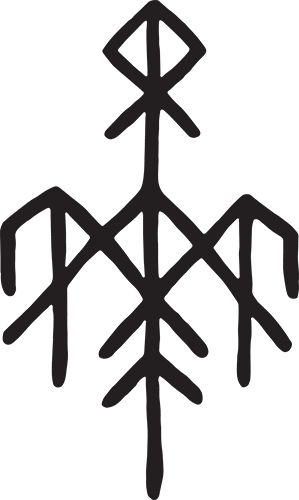
Such is that appeal, I now feel moved to present more of their work, in what is without doubt my favourite song in their entire catalogue. Helvegen is a hauntingly beautiful track which delves into themes of death, the afterlife, and the sociocultural importance of honouring those who have passed.
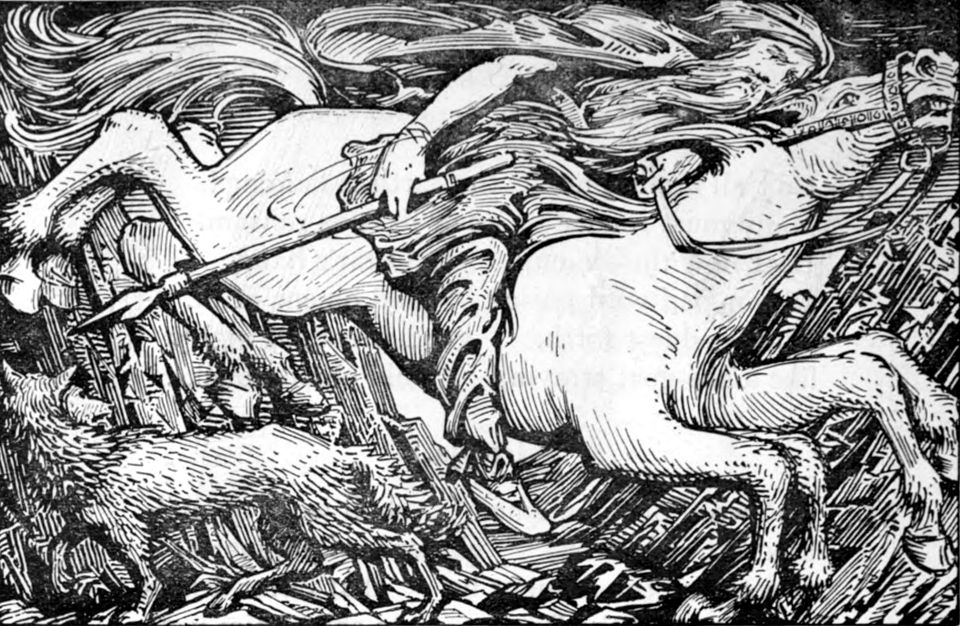
The title, which translates to ‘the road to Hel,’ (not to be confused with the ‘Hell‘ of Christianity and Islam) refers to the path to the underworld, one which we are all destined to tread. It explores not only mortality itself, but also the importance of songs to both guide the dying in their passing and to proclaim the permanence of one’s legacy beyond death.
Despite a theme which some may perceive to be a morbid one, when ‘Helvegen’ was uploaded onto social media platforms, it immediately triggered widespread acclaim. And when a music video generates responses such as those that follow, you somehow know it is something special:
‘This is already in my will. I will be buried to this song. And my children shall be there to sing me into the next [life].’
‘I’ve never wanted to have a song for my passing, until I heard this. Beautifully haunting.’
‘This song touches my soul.’
‘Want this song to be played on my funeral. A fitting end for a life.’
‘How does something unlock a core memory of something you’ve never experienced.’
‘I feel like it’s sending my soul someplace it would call home.’
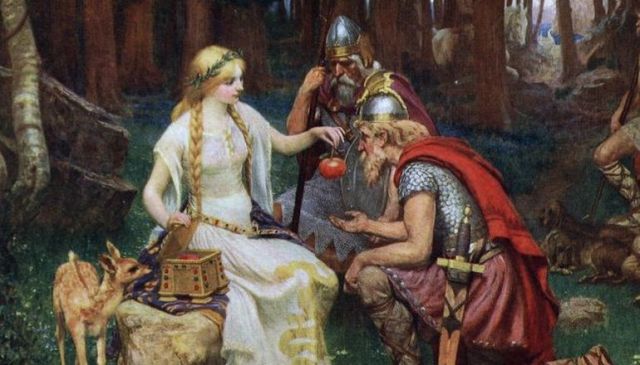
The song, which was influenced by a global resurgence of interest in Norse culture and spirituality, is particularly relevant in today’s rapidly changing world as modern audiences seek to understand their own mortality and the significance of legacy.
Rich in the imagery of Viking beliefs and traditions, the lyrics speculate on who will sing for the individual after they have passed away, thereby immortalising their memory and perpetuating their spirit legacy through song and story.
Helvegen begins with the singer, Einar Selvik, asking a question: who will continue the circle once he is dead? A sobering question.

It is not, however, the death of self which creates a palpable sense of unease in these opening lines, it is the prospect of death of the all-important life-song.
Hvem skal synge meg
— (Who will sing me)
i daudsvevna slynge meg
— (into the death-sleep sling me)
når eg på Helvegen går
— (when I walk on the path of death)
og dei spora eg trår er kalda, så kalda
— (and the tracks I tread are cold, so cold)
The choice of the verb ‘sling’ in relation to the ‘death sleep’ is an interesting one. The term is not limited to throwing rocks, but refers here to what one does with a child as they are put to bed, in an action often accompanied by music.
To settle a child to sleep with song is to give life in two senses: the regenerative nature of sleep, and also the underlying preservative nature of life itself delivered through music. When combined with the percussive heart-drum-beats in the song, Helvegen loses all sense of melancholy, and becomes, instead, a lullaby.
The ‘song’ in this case isn’t simply an archive of life, but it is the substance of life. Therefore, the act of singing is the passing on of life by successive generations to those who are on their own journeys.
Eg songane søkte
— (I sought the songs)
Eg songane sende
— (I sent the songs)
då den djupaste brunni
— (when the deepest well)
gav meg dråper så ramme
— (gave me the drops so touched)
av Valfaders pant
— (of Death-father’s wager)
We see here a reference to Odin’s sacrifice in which, at Mimir’s well, he forfeited an eye in exchange for knowledge of the runes after first of all hanging from a tree for nine nights. [See also the post ‘Evolution of my Runes’.]

Odin’s path to rune knowledge led, not only to insight into runic typography, but of their intrinsic power within language – including the language of music.
Therefore, when Selvik sings ‘I sought the songs, I sent the songs,’ he testifies to his own difficult journey, and draws parallels with Odin’s sacrifice for his own quest to deliver the gift of music — a gift which is also life.
Alt veit eg, Odin
— (I know it all, Odin)
var du gjømde ditt auge
— (where you hid your eye)
In these brief lines, the artist acknowledges that Odin sacrificed his eye to wisdom itself – knowledge in song – and declares that he, too, has devoted himself to this path.
Hvem skal synge meg
— (Who will sing me)
i daudsvevna slynge meg
— (into the death-sleep sling me)
når eg på Helvegen går
— (when I walk on the path of death)
og dei spora eg trår er kalda, så kalda
— (and the tracks I tread are cold, so cold)
Årle ell i dagars hell
— (early in the days end)
enn veit ravnen om eg fell
— (still the raven knows if I fall)

Ravens played a key role in Norse mythology, symbolising many things, including wisdom, knowledge, power and magic.
In Germanic paganism, Odin is accompanied by two ravens: Huginn (memory) and Muminn (‘thought’).
Among the lyrics’ archaic language and Norse symbolism there is a reassurance here: through song, others will remember you — the raven will know — even should you fall.
Når du ved Helgrindi står
— (When you stand by the Gate of Death)
og når du laus deg må riva
— (and you have to tear free)
skal eg fylgje deg
— (I shall follow you)
over Gjallarbrua med min song
— (across the Resounding Bridge with my song)
In this emotionally intense verse, the singer is making a promise to you, the listener – a promise which translates as:
‘When you face death, I will follow you; I will remember you with song, and your name will never be forgotten.’
This solemn pledge is compelling, immediate and personal. There is also a powerful, mystical energy in the climactic lines that follow:
Du blir løyst frå banda som bind deg!
— (You will be free from the bonds that bind you!)
Du er løyst frå banda som batt deg!
— (You are free from the bonds that bound that you!)
It should be noted that the first line here is in the future tense, and the second is in the present/past. This implies that, even as they were heard in real time, something has happened between the lines; something dynamic.
The singer has promised to keep your memory alive, to follow you across the bridge to Hel itself. You no longer need live your life bound by fear.
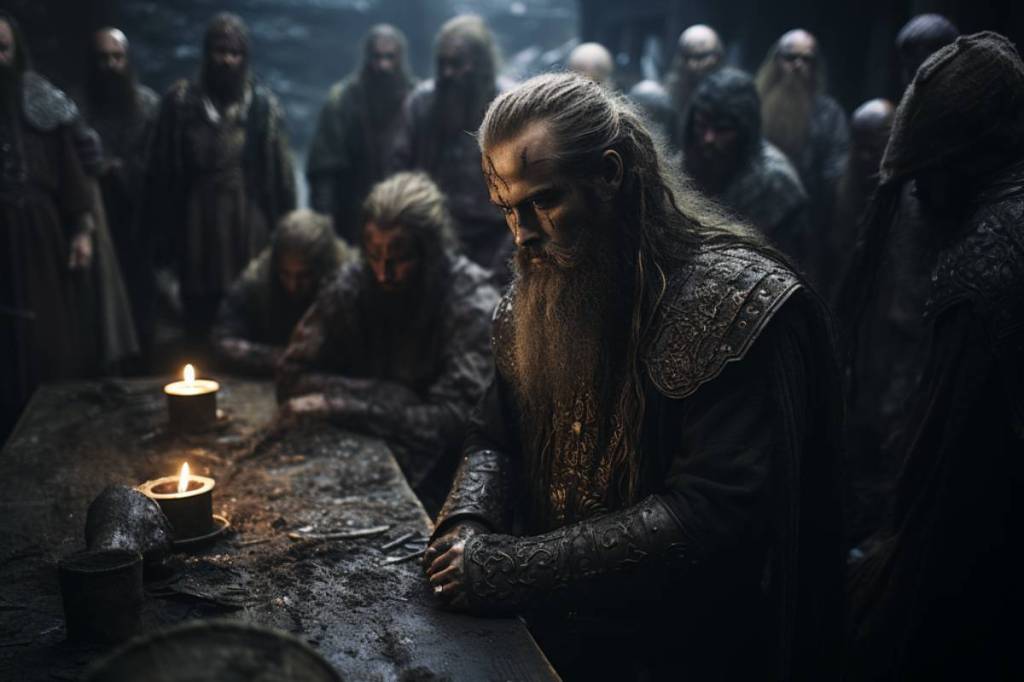
In closing, Selvik adopts a spoken manner in which he summarises the message by quoting lines taken directly from the ancient Icelandic Old Norse poem, Havamal:
Døyr fe, døyr frender
— (Cattle die, kinsmen die)
Døyr sjølv det sama
— (You yourself will also die)
men ordet om deg aldreg døyr
— (but the word about you will never die)
vinn du et gjetord gjevt
— (if you win a good reputation)
Døyr fe, døyr frender
— (Cattle die, kinsmen die)
Døyr sjølv det sama
— (You yourself will also die)
Eg veit et som aldreg døyr
— (I know one that never dies)
dom om daudan kvar
— (the reputation of those who died)
Through life-song, immortality of a kind is given to those doomed to die. The requisite knowledge and skill in the art of language and music is itself achieved through great sacrifice. But as the above Havamal extract states, immortality is not obtained though magic. Instead, it is one’s life, deeds and reputation which permit the alchemy to work.
Odin and others who have followed his cold path have made great sacrifices to achieve this ability, and it is a tradition we, too, have inherited – memorialising the lives and deeds of those who have passed, as we, too, would one day wish to be remembered.
This then is ‘Helvegen.’ There is little for me to add, aside from to echo one listener’s assertion and adopt it as my own:
‘If I can’t have Helvegen played at MY funeral, I’m NOT dying.’

 RAVEN MOON