In the post titled ‘Evolution of (my) Runes‘, written in July last year, I explained how I made a set of runes for my own use as a divining tool. To give context I added a tightly-abridged history of runes, explaining how this ancient writing system once used by the Nordic and Germanic peoples, has long been considered to possess mystical qualities and has since been adopted by many (myself included) as a means of gaining insights.
To augment and enliven my account I included a piece of music – Nio nätters led – by Swedish artist Forndom, in which, through song, he depicts the story of the runes’ discovery by Odin.
As I’ve mentioned previously, I have an inexplicable fascination for Norse mythology and culture, and in my earlier post I speculated on why this may have come about. In so doing, I attempted to intellectualise the phenomenon by using my east of England birthplace as a logical reason. After all, this region was widely settled by those we now widely refer to as ‘Vikings,’ so why shouldn’t I feel an affinity? It’s only natural, surely.
Since writing that post my curiosity into the origins of perceived kinship increased. And so, in January this year, to help me more fully understand the reason for this sense of connection, I decided to investigate my genealogical roots by way of a DNA test.
Unsurprisingly, of the three ancestral regions constituent in the resulting analysis, 33% of my DNA sample was representative of Germanic Europe. Little wonder, then, that I should feel such affinity, for a significant strand of my ancestry – no less than a third – is rooted in the very culture to which I now sense a level of alignment.
As I have said, runes are one divination tool I regularly use.
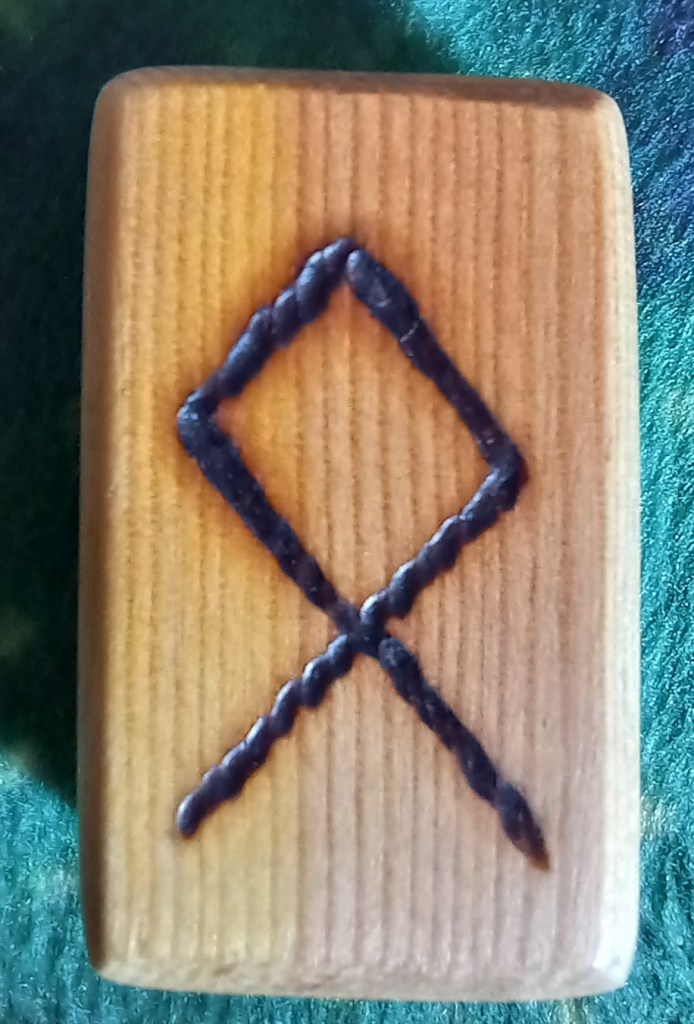
And of those runes that have presented recently, one in particular has been notable by its frequency. That rune is ‘Othila.‘
The rune’s symbol is thought to represent the roof and beam structure of a house, and carries with it the wider meaning of heritage, home and ancestry.
Writing of Othila in her book ‘The Runes Box,’ Lona Eversden states:
‘We are all inclined to leave our upbringing behind to make our way in the world, but that journey often turns out to be a quest for the security of home and hearth. This rune reminds us that the lessons handed down by our elders should be integrated with our own insights if we are to truly understand life’s meaning.’
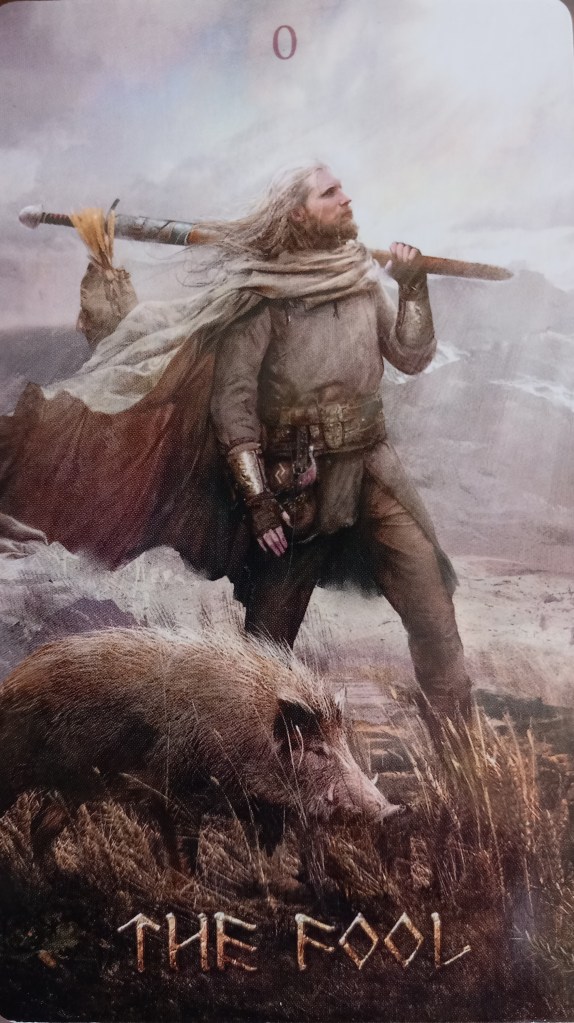
Such a quest is represented in the first of the Tarot’s Major Arcana, ‘The Fool‘.
The card depicts him setting out on his journey, fresh faced and eager, an independent spirit intent on shaping his future.
All he can control, however, is his first step, and here golden-bristled Gullinborsti is by his side to counsel caution when needed … in much the same way as our ancestors – our hidden allies – are with us.
Even when our journey is at an early stage and we remain inexperienced for what lies ahead, our slate is never truly blank. For deep within us are the unconscious memories and emotional associations of our ancestral inheritance.
The Tarot’s ‘High Priestess‘ symbolises this ‘inner knowing,’ a powerful force of which we may be unaware, yet can tap into at the right time, prompted by an instinctive intuition.
It is this powerful spiritual force that can unleash inner-strength and the will to overcome life’s hurdles – not through brute force, but compassion, endurance, patience and courage.
This force, too, is the legacy of our forebears.
It is ours to draw upon at times of need.
It was while contemplating my own ancestral strands and heritage recently that I listened to ‘Odal,’ a recording by Norwegian musicians Wardruna. Just as the rune Othila represents heritage and inheritance, so too does ‘Odal,’ both words having been derived from the same proto-Germanic root.
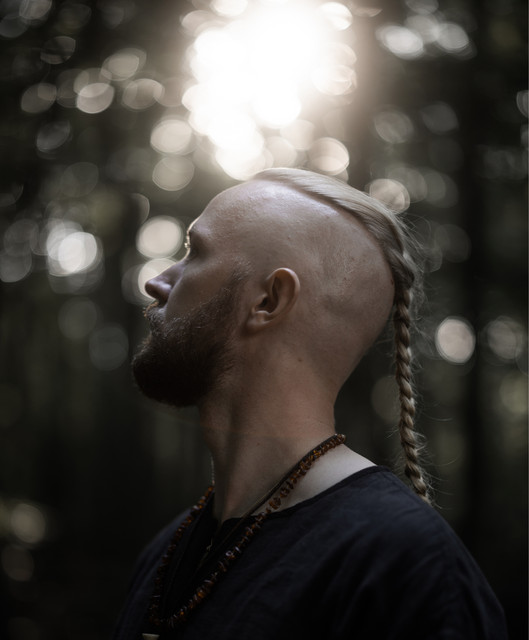
Wardruna
I presented work by Wardruna in a previous post, ‘Hi-bear-nation,’ published last November. And like the lyrics of the song in that post, those to Odal were in old Norse and therefore incomprehensible to me.
In both examples, however, the vocalist’s resonance and harmony blends with drum, lyr, flute and taglharpa to become yet another instrument contributing to the whole. Like lines in opera, emotion is conveyed irrespective of the language, as the voice imparts meaning and has soul.
This is enriched further and given greater clarity once the lyrics are presented in English:
We are an ancient tree
With fresh blossoms
Towards the sun we stretch
Forward to grow
Listen!

Far down in the root and in the cycles of years
Chant the old
Listen!

Far down in the root and in the cycles of years
In the bark lay wounds
They attest of honour
They attest of misdeed
Some hurt more than others

Look deep into my eyes so blue
You must understand
Remember that all people will in future leave

The Night it will come
I give you your heritage
If you want
It will not leave
Heavy it weighs
Remember, do not take more than you can carry

Deep in the earth
Roots give you direction
When storms rage
The creaking
Chants

Look deep into my eyes so blue
You must understand
Remember that all people will in future leave

The Night it will come
I give you your heritage
If you want
It will not leave
Heavy it weighs
Remember, do not take more than you can carry

For every sprout
We become taller and deeper
For every sprout
We become taller and deeper

Odal
Odal
Here we are being shown the mutual dependency of all living things and the importance of becoming grounded in one’s roots and heritage.
By using a tree as a metaphor, the song shows us that as new buds stretch towards the sun to grow, they are nourished and supported by roots deep in the ground; roots which resonate with the old, ancestral songs.
Just as the bark of a tree bears witness to its life story, we carry with us the consequences of our actions, good and bad, honour and shame. The line ‘… some hurt more than others,’ is a stark reminder that some wounds run deep and are not easily healed. Some scars are carried for life.
Moreover, the song’s chorus reminds us of the importance of accepting the passage of time as inevitable, as is the transference of one’s legacy to the next generation.
The singer offers their ‘odel,’ – an inheritance or birthright – to us, but reminds us that it weighs heavily and ought not to be taken lightly.
The song (to hear it click on the link at the foot of this post) then ends with the message that, as every sprout grows, we must dig deeper into our roots to stay grounded and strong. The odal represents one’s inheritance and familial legacy, reminding us to stay connected to our past as we move towards the future.
This sentiment is expanded upon in Lorna Eversden’s book, in which she summarises Othila’s guiding principle:






 RAVEN MOON