
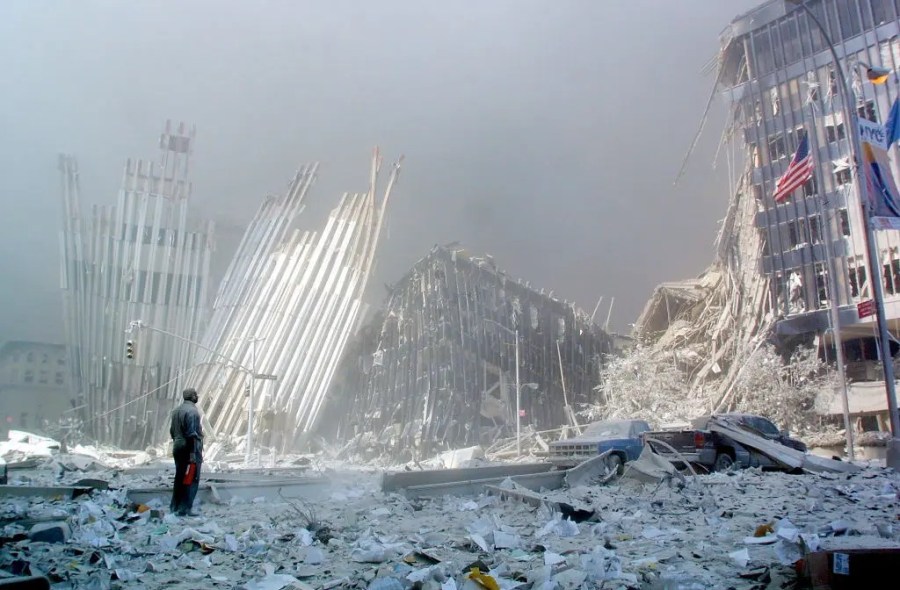
In the history of modern high-rise constructions only three have been brought down by fire. When these three buildings collapsed, not only did they drop at free fall speeds into their own foundational footprints, but all three came down on the same day – September 11, 2001.
First, a word or two on the title of this post.
It cannot be denied that, since the attacks of 9/11, the global political landscape has been irreversibly altered, and none of that change has been good. For this reason alone, the many unanswered questions surrounding that tragic event continue to have relevance every hour of every day.
This is a piece of writing that I’ve long intended to produce as it is a subject that I am passionate about. It is perhaps as well that I held off until now, for what follows will be an entirely different essay to the one I may have written years ago; a time when I was a ‘keyboard warrior’, opposed to global oligarchy.
Whereas I may once have sought to convince you, now I simply lay out the facts, step back and permit you to interpret them as you see fit. As will be seen, the facts speak for themselves.
Since that dreadful Tuesday of September 11, 2001, I have been discomfited by the ensuing and outrageous official narratives. However, before you dismiss what follows as ‘another lunatic conspiracy theory,’ I assure you that I proffer no theories here, nor outline any conspiracies.
Actually, no, for there is one theory that needs to be cited at the outset:
‘Nine Eleven’ is shorthand for four synchronised terrorist attacks allegedly carried out by the Islamist extremist group, al-Qaeda.
Coordinated by the group’s boss, Osama bin Laden, nineteen Muslim terrorists hijacked four commercial airplanes, deliberately crashing two into the upper floors of the North and South Towers of the World Trade Center complex and a third plane into the Pentagon in Arlington, Virginia. The fourth hijacked airliner crashed in Shanksville, Pennsylvania.
The nineteen terrorists were killed in the attack. Their leader, we are told, was himself subsequently killed by a team of U.S. Special Forces, and according to officials, he was allegedly buried at sea during the team’s return journey …
‘ … because no country would accept his remains.’
This was highly controversial. Equally questionable was the decision to classify any photographic or DNA evidence of bin Laden’s death.
Dead conspirators can’t talk, and no verifiable proof of such a collusion has been, nor can ever be, provided. This alleged plot, therefore, can only ever be a theory. A conspiracy theory.
This is, however, one conspiracy theory that underpinned all official narratives within hours of the attacks and continues to be peddled across all forms of media – to the exclusion of all other possible explanations.
Why should we question these narratives? One reason may be found in the definition of the word ‘narrative’ itself:
‘Narratives’ are stories that shape understanding and perceptions.
Whether we like it or not, we are influenced by the stories we hear. This renders us vulnerable to manipulation. It is therefore vital that we ask questions – especially when presented with stories that simply don’t make sense, or that defy science, natural laws and logic.
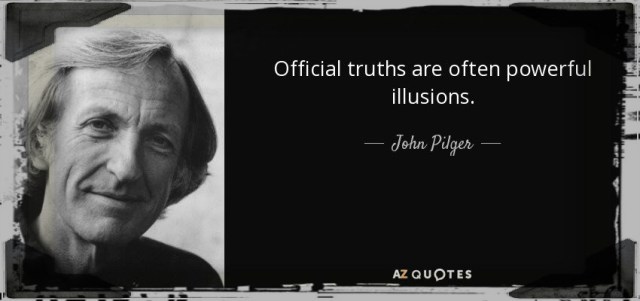
My post titled ‘Powerful Illusions’ shows the importance of critical thinking in the face of a pervasive media.

The post incudes a quote from Polish-American diplomat and political scientist, Zbigniew Brzezinski, who stated:
‘Shortly the public will be unable to reason or think for themselves. They’ll only be able to parrot the information they’ve been given on the previous night’s news.’
In the case of 9/11 we are only too familiar with the media presentation.
Long were we subjected to shocking scenes of the attack and its aftermath as these were broadcast repeatedly – one could even say ‘forcefully’ – across all networks, on all platforms.

We watched in horror as we were shown people leaping to their deaths from the burning towers. Then came the shocking collapses themselves. These scenes were horrific and distressing for all who viewed the footage.
It is well understood that when emotions are high rational thought is compromised. When we are impassioned, our ability to apply logic by analysing what we see in a linear step-by-step manner, is reduced. Instead, we become susceptible to authoritative interpretations – however irrational they may have once appeared.
This suggestibility is multiplied when those renditions are incessantly and consistently repeated.
For example, we were shown footage of the two airliners flying into the towers, triggering colossal fireballs. We saw the ‘planes slice into the structures, leaving distinct aircraft-shaped profiles. These were thicker at the centre, each gash tapering down, right and left, where the wings had cut cleanly through the concrete and steel.

Perhaps we didn’t question this at the time. The scenes were horrendous, and highly emotive.
And, after all, had we not seen numerous cartoons in which the likes of Wiley E. Coyote did the same into the sides of mountains?

Similarly, in the case of the Shanksville crash site, we were shown where the aircraft had crashed into the ground – burying itself so deep into the earth that it was no longer visible. All that remained was another neat profile.

Here again, didn’t Wiley E. Coyote do just the same in the cartoons we saw as children?

But those were cartoons. We are no longer children.
So then, let us now explore these scenarios, applying adult logic and reason.
One of the most serious threats to airliner safety is that of aircraft bird strikes, also known as bird ingestion, bird hits, or BASH (Bird Aircraft Strike Hazard).
A full-sized Canada goose, for example, can weigh up to 14 pounds. When such a bird hits a ‘plane at high speeds the impact can be likened to a bowling ball colliding with a window. Damages from bird strikes in the U.S. from 1990 to 2019 were estimated to be as high as $500 million per year, according to the FAA.
Here are some examples of damage from bird strikes:
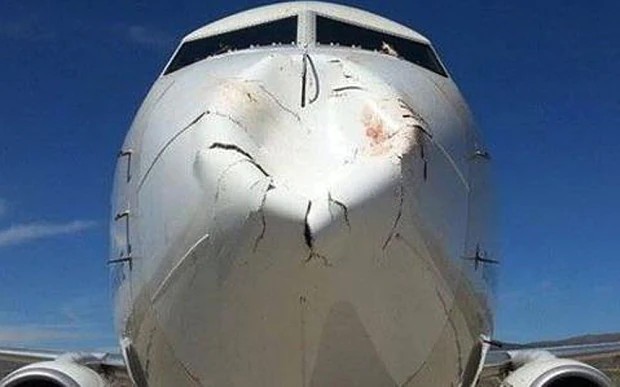


How can a hollow-boned creature of flesh, blood and sinew cause such devastation to large, robust-looking airliners? To answer this we must look at airliner construction.
Due to its strength-to-weight ratio and ease of fabrication, aluminum is the primary material for the vast majority of aircraft in operation. The use of composite materials has increased in recent designs, though not extensively.
Whilst strength is important, the weight to power correlation is paramount. For airliners to take to the air they must be lightweight, and as we can see from bird strike damage, this makes them fragile.
Now let’s look at the towers themselves.
More than 425,000 cubic yards of concrete were required to construct the World Trade Center, enough to pave a sidewalk from New York City to Washington, D.C.
Furthermore, at least seven foundries supplied more than 200,000 tons of structural steel —more steel than was used to build the Verrazzano-Narrows Bridge, the longest suspension bridge in the United States, connecting Staten Island to Brooklyn, New York.
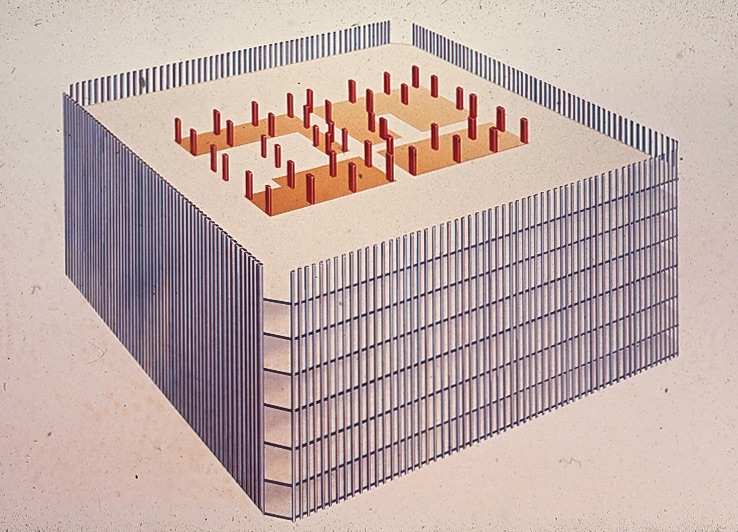
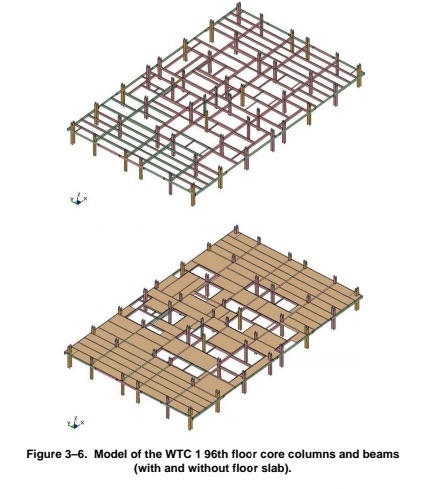
The buildings used high-strength, load-bearing perimeter steel columns which acted as Vierendeel trusses. Although the columns themselves were lightweight, they were spaced closely together, forming a strong, rigid wall structure.
There were 59 perimeter columns, narrowly spaced, on each side of the buildings. In all, the perimeter walls of the towers were 210 feet (64 m) on each side, and the corners were beveled.
The perimeter columns were designed to provide support for virtually all lateral loads (such as wind loads) and to share the gravity loads with the core columns.

Moreover, in view of past events, structural engineers working on the WTC project had also considered the possibility that an aircraft could crash into the building.
In July 1945, for example, a B-25 bomber that was lost in the fog crashed into the 78th and 79th floors of the Empire State Building. A year later, another airplane crashed into the 40 Wall Street building, and there was another close call at the Empire State Building.
Consequently, when designing the World Trade Center, architects considered the potential impact of a jet airliner, such as the Boeing 707, which might be lost in the fog and seeking to land at JFK or Newark airports.
A 1964 document in the files of the Port Authority of New York and New Jersey, summarized a structural analysis of the Twin Towers carried out by the firm of Worthington, Skilling, Helle & Jackson. One of the points said:
‘The buildings have been investigated and found to be safe in an assumed collision with a large jet airliner (Boeing 707–DC 8) traveling at 600 miles per hour.
Analysis indicates that such collision would result in only local damage which could not cause collapse.’
For those of us without knowledge of architecture or civil engineering, it is easy to assume that it was airliner impact that caused the towers to collapse. However, not only had the buildings been designed and constructed to withstand such shock damage but, according to the National Institute of Standards and Technology [NIST], the agency that investigated the World Trade Center’s destruction, it was fire that brought the towers down.
It is worth pointing out here that NIST is not a neutral, independent organisation. Far from it, for it is an agency of the US Department of Commerce. While NIST was writing its report, therefore, it was an agency of the Bush administration.
Moreover, according to a statement signed by over 12,000 scientists (including 52 Nobel Laureates and 63 recipients of the National Medal of Science), NIST has been guilty of engaging in:
‘… distortion of scientific knowledge for partisan political ends.’
Irrespective of any ‘official’ report, the facts are irrefutable:
The North Tower [WTC1] was struck at 8:46 a.m. causing damage to floors 93 through to 99, which were then engulfed in flame. The tower collapsed at 10:28, after burning for one hour and 42 minutes.
The South Tower [WTC2] was struck at 9:03 a.m., causing similar damage, this time to floors 77 through to 85. It collapsed at 9:59 a.m. It had been burning for only 56 minutes.
Contrasting with their catastrophic failure to withstand short-term heat, a more recent tragic event here in the UK clearly demonstrated the fire-resilience of high-rise buildings.

On June 14, 2017, fire broke out in the 24-storey Grenfell Tower Block, North Kensington, London. The entire tower block was consumed by flames, and burned for over 60 hours. The tower remained standing.

To date, Grenfell Tower still stands.
So, why were the WTC fires so disastrous? Before the dust had even settled from the cataclysmic collapses, architects and civil engineers around the world were perplexed.
‘Steel buildings do not globally collapse due to fire, and yet on 9/11, we’re told that three of them came down from office fires alone in the same day.’ – Architects & Engineers for 9/11 Truth
The widespread scepticism of experts was not only due to the fact that the towers had collapsed, it was the manner in which they came down that raised red flags among architects and engineers alike.
Despite damage having been inflicted predominantly to one side of each tower, instead of falling toward their weakest points, both collapsed isotropically into their own foundational footprints. Furthermore, they fell at free-fall speed. This last point is highly significant.
NIST’s theory of the free-fall collapses hinges on the idea that the upper section of each tower could continuously accelerate through the lower stories at nearly the rate of gravity, while in the process completely dismembering the steel frames and pulverizing nearly all of the concrete to a fine powder.
However, no modeling or calculations were submitted to demonstrate that such behaviour was possible. Instead, NIST arbitrarily stopped its analysis at the moment of ‘collapse initiation,’ asserting that total collapse was ‘inevitable’ once the collapses began.
Such an assertion is contrary to established laws of science.
Based on Newton’s Third Law of Motion, which states that for every action there is an equal and opposite reaction, we know there would have been a deceleration of each tower’s upper section if it had impacted and crushed the intact structure below it.
The absence of deceleration can only suggest that another force (i.e., explosives) must have been responsible for destroying the lower structure before the upper section reached it.

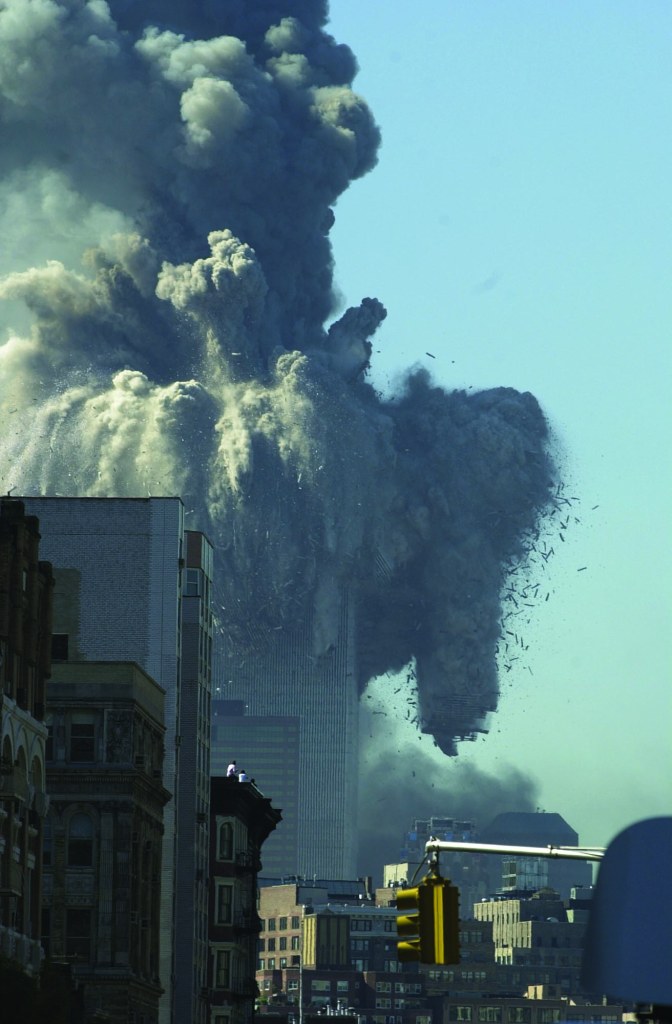
In addition to the wealth of video and photographic evidence regarding the destruction of the Twin Towers, there is an abundance of eyewitness accounts. Indeed, the perception that explosions had destroyed WTC 1 and WTC 2 was so prevalent among firefighters that it became widely discussed.
‘At that point, a debate began to rage because the perception was that the building looked like it had been taken out with charges.’
-Christopher Fenyo in his WTC Task Force Interview.
‘I thought it was exploding, actually. That’s what I thought for hours afterwards … Everybody I think at that point still thought these things were blown up.’
– John Coyle in his WTC Task Force Interview, “
‘[A]ll of a sudden…I looked up, and… [t]he thing started peeling in on itself…. I started running…and the whole time you’re hearing “thume, thume, thume, thume, thume.” I think I know an explosion when I hear it.’
– Craig Bartmer, former NYPD officer
‘[W]e heard this sound that sounded like a clap of thunder…. [T]urned around — we were shocked…. [I]t looked like there was a shockwave ripping through the building and the windows all busted out…. [A]bout a second later the bottom floor caved out and the building followed after that.’
– Dany, Medical Student
‘And then it was like another two, three seconds, you heard explosions. Like BA-BOOOOOM! And it’s like a distinct sound…BA-BOOOOOM! And you felt a rumble in the ground, like, almost like you wanted to grab onto something.’
– Kevin McPadden, unaffiliated, first responder
Architects & Engineers for 9/11 Truth is a non-profit organization of architects, engineers, and affiliates dedicated to establishing the truth about the events of September 11, 2001.
They assert that the WTC Towers were destroyed by waves of explosions that pulverized the building contents and hurled steel beams up to 600 ft in all directions. The evidence is compelling.
Nine Eleven is a colossal, multi-faceted narrative, way beyond the scope of this blog. My intention in writing this has simply been to highlight a small number of the many elements that ‘don’t stack up’.
When one lifts the lid on the 9/11 worm can, the contents are shocking, for what is revealed is a writhing mass of high-level skullduggery, reeking of corruption.
Such critical examination of the events exposes innumerable questions. For example, where was the US’s air defence that day? Was it simply coincidence that, in planning their attacks, the terrorists chose a day in which multiple military exercises were scheduled to take place?
If so, this was convenient, for the drills effectively stripped the US eastern seaboard of its air cover, and placed numerous false blips on air traffic radar, causing mass confusion as the events unfolded?
Furthermore, how, fifty minutes into the attack, did an unauthorised airliner succeed in approaching and striking the Pentagon – the nation’s primary defense centre, and one of the most heavily-defended buildings on the planet?
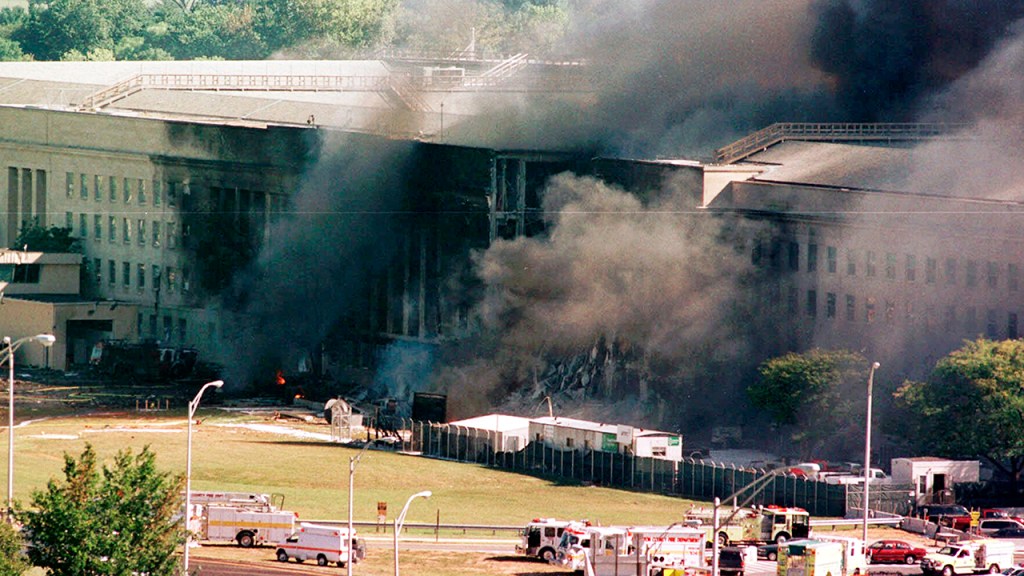
The hijackers had, we are led to believe, clocked-up several hours of flying time in single-engine trainer aircraft prior to the attacks.
How, then, were they able to pilot Boeing 767 and 757 aircraft with pinpoint precision, and while flying under duress – despite having no experience of flying airliners? This is just one of many questions raised by airline pilots themselves.
It is only when one questions official narratives that numerous flaws are exposed.
I have, however, left one major element of the 9/11 riddle until last. And that is Building Seven.

WTC Building 7, also known as the Saloman Building, is often referred to as 9/11’s ‘smoking gun.’ This 47 storey building collapsed in the afternoon of 9/11, and with it tumbled the flimsy fragments of official-account credibility.
Built in 1984, Building 7 was 100 yards from the twin towers and housed several intelligence and law enforcement agencies, the NYC Office of Emergency Management’s Emergency Operations Center, along with several major financial institutions.
It was not hit by an airplane and suffered only minimal damage from debris falling from the North Tower. This debris triggered isolated office fires on several floors. At 5:20 p.m. on 9/11, despite incurring only minimal damage, the building completely collapsed – and like WTC 1 & 2, did so in free-fall into its own footprint.
Numerous eyewitnesses, including members of the Fire Department of New York (FDNY), other first responders, and multiple news sources, made statements indicating that there had been foreknowledge of WTC’s collapse, despite the fact that no skyscraper in history had ever completely collapsed due to fire.
Foreknowledge of an extremely unusual event suggests that the foresight must originate from those who had inside information about, and/or control over, the event itself. In the case of Building 7’s collapse, such prior awareness can only suggest that it was subjected to a controlled demolition.
Incontrovertible proof of foreknowledge was broadcast live to the world by the BBC.
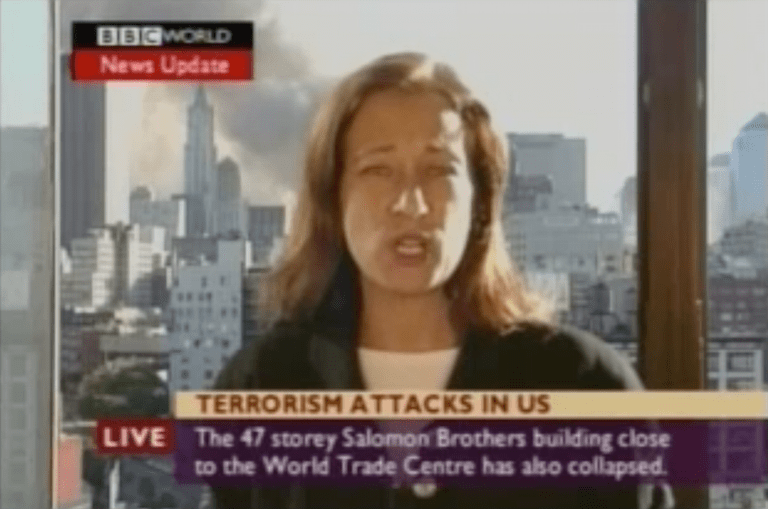
Twenty minutes before WTC 7 collapsed, BBC correspondent, Jane Standley reported that it had already done so. Behind her, however, a fully intact Building 7 could be seen — still standing.
How did the BBC’s reporting team come by such foreknowledge? The BBC later asserted that their premature broadcast was ‘an error.’
Whoever was responsible for the 9/11 attacks, the event was undeniably one of mass murder, and the World Trade Centre a massive crime scene. Despite this, and despite the BBC’s demonstrable foreknowledge of one aspect of the crime, no investigation has been conducted, nor adequate explanation offered for their apparent ‘error.’
Immediately following 9/11, the US’s security services – who, it must be said, had failed monumentally to foresee and forestall the attacks – began gathering evidence, all of which served to confirm the Bush administration’s immediate hypothesis of terrorism engineered by al Quaeda.
And let us not forget, 9/11 immediately triggered the US’s ‘War on Terror.’ Rather than being an armed conflict against a nation or a faction, this was to be a war against a concept – a war with no pre-determined goal – nor end.
Some of the discoveries which supported this wide-ranging conflict agenda were mind-boggling:
In March 19, 2002, Guardian correspondent, Anne Karpf, covered this topic in her article titled, ‘Uncle Sam’s Lucky Finds.’ She wrote:
‘ … never in the history of modern warfare has so much been found so opportunely.
It started the day after the attacks on the twin towers, with the discovery of a flight manual in Arabic and a copy of the Koran in a car hired by Mohammed Atta and abandoned at Boston airport. In the immediate shocked aftermath of the attacks, these findings were somehow reassuring: American intelligence was on the case, the perpetrators were no longer faceless.
In less than a week came another find, two blocks away from the twin towers, in the shape of Atta’s passport. We had all seen the blizzard of paper rain down from the towers, but the idea that Atta’s passport had escaped from that inferno unsinged would have tested the credulity of the staunchest supporter of the FBI’s crackdown on terrorism.’
For those who have accepted without question official 9/11 narratives, material such as the above makes for difficult reading. It creates a significant level of discomfort.
This is understandable, for it’s unthinkable that any government could commit such a dastardly and wicked crime on its own people. After all, not only were the attacks of 9/11 horrific, they resulted in years of widespread global unrest, armed conflict and countless deaths.
The harsh reality is that imperial powers have regularly staged such attacks as pretexts for consolidating power or going to war:
When Japan’s army in 1931 decided to take over Manchuria, it blew up the tracks of its own railway near the Chinese military base in Mukden, then blamed Chinese solders. This ‘Mukden incident,’ which occurred on September 18 and is still known in China as ‘9/18,’ triggered the Pacific part of World War II.

In 1933, after the Nazis took power in Germany, they started a fire in the Reichstag (the German parliament building), blamed the Communist Party, then used the event as a pretext to imprison enemies, annul civil liberties and to consolidate power.
Later, in 1939, Hitler required a pretext to attack Poland. Germans dressed as Poles staged raids on German outposts on the Polish–German border, in some cases leaving dead German convicts dressed as Polish soldiers at the scene. The following day, Hitler referred to these ‘border incidents,’ and launched his attack on Poland – in ‘self-defense.’ So began World War II.
The United States itself has consistently used lies to start wars:
The Mexican–American war, was based on President Polk’s false claim that Mexico had ‘shed American blood on the American soil.’
The Spanish–American war was based on the false claims that Spain had sunk the US battleship Maine.
The war in the Philippines had been based on the false claim that Filipinos had fired first …
… and the US’s full-scale commitment to the Vietnam war had been based on the Tonkin Gulf hoax.

Such uncomfortable geopolitical realities are often readily dismissed as ‘crazy conspiracy theories.’
However, conspiracy theories in the generic sense can either be rational ones, based on good evidence and logical inferences, or irrational theories, based on false or cherry-picked evidence and illogical inferences.
The derisive and widespread use of the term ‘conspiracy theory‘ falsely implies that all conspiracy theories are of this irrational type. As such, theories in general are spuriously regarded with equal disdain. There is therefore a tendency for people to discredit a theory without having to provide any evidence against it, because simply to call it a conspiracy theory is to damn it.
Columnist Paul Krugman, commented on this tactic, stating:
‘The truth is that many of the people who throw around terms like ‘loopy conspiracy theories’ are lazy bullies who [as one observer put it] want to ‘confer instant illegitimacy on any argument with which they disagree.’ Instead of facing up to hard questions, they try to suggest that anyone who asks those questions is crazy.’
In closing, as we have seen, the official narrative hinges on an alleged collusion between Osama bin Laden and nineteen Muslim terrorists. This is, by definition, a ‘conspiracy theory’.
Be that as it may, since 2001 those who continue to question the implausible official line in an effort to ascertain truth are immediately discredited, by being branded as ‘conspiracy theorists’ by a venal mainstream media – including the BBC.
Instead, the far-fetched inconsistencies of the official account are strenuously defended by the global media. And this raises another, vital question.
What is the true purpose of our mainstream media? Does it exist to report accurately and authentically? Or is its primary role one of deception, misinformation and manipulation?
And, if the latter, should we really be funding it?
 RAVEN MOON
Well done Steve, a thought provoking narrative.
LikeLike
Thanks, John. The 9/11 narrative is highly complex and confusing. By design. It’s only when you break it down to basics can you see through the puzzle.
What I’ve tried to ask here is, ‘can aluminium airliners, for which birds are a serious hazard, slice through concrete and steel without fragmenting on impact?
9/11 only begins to make sense once one factor is removed from the equation … the airliners themselves.
LikeLike