

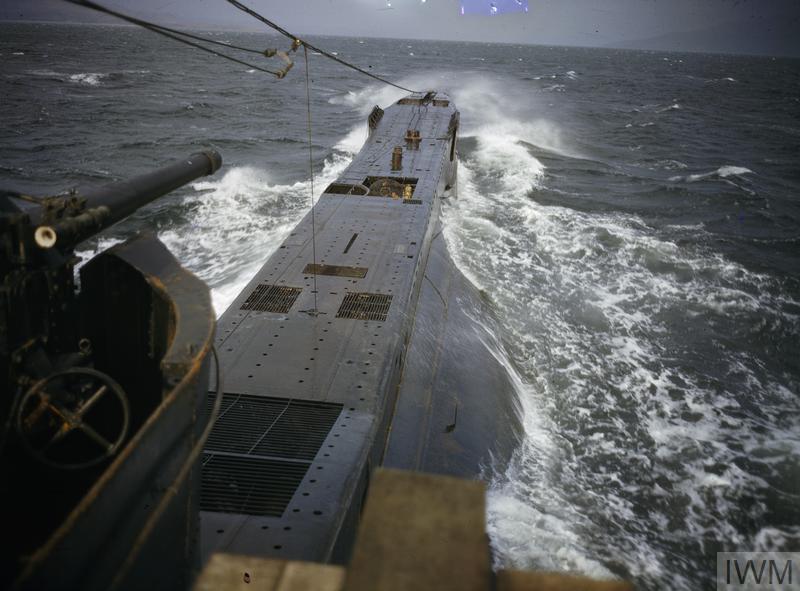
Prior to writing my post, ‘Six Weeks Silent Service,’ it was necessary for me to to obtain details of life aboard a World War Two submarine. This meant accessing a number of useful websites.
Information from these sites enabled me to gain a valuable insight into what may have been my late father’s experience while serving briefly aboard the British ‘T’ Class submarine, HMS Taku in 1941.
However fruitful my research may have been, it had another consequence:
The day following my inquiries, an unsolicited video popped into my YouTube home screen. The film, totally at odds with all others displayed, was titled ‘Close Quarters’ and featured … a British, WW2 submarine.

This remarkable synchronicity was, of course, courtesy of those insidious AI algorithms employed by internet giants such as Google, by which we are all survielled, our interests and browsing activities spied-upon and used (supposedly) for some undefined ‘greater good.’
To me, this endless scrutiny of our activities is the worst kind of surveillance, in that it is overt, unrelenting and aggressive. We are bugged 24/7, for which we are expected to accept such spying without complaint, to regard it as beneficial in some way and to be grateful.
Would my life have been any the poorer without this provision of ‘suggested viewing’ based on my web browsing? No, I don’t think so. That said, my attention had been drawn to the video, so I watched it.
And so, as I’m always on the look out for suitable blogging material, I considered that I may as well make the most of the invasion on my privacy and write about YouTube’s ‘suggested viewing’.
What follows, then, serves as an appendix to my November 30 post, ‘Six Weeks Silent Service.’
The year was 1943. Britain had been at war for more than three years. In that time, Britons had witnessed a succession of catastrophic failures, such as those at Dunkirk and Norway. On the ‘home front’ they had experienced the Battle of Britain, the Evacuation of children, and the horrors of the Blitz, whilst also being subjected to intensive rationing and long-term hardship.
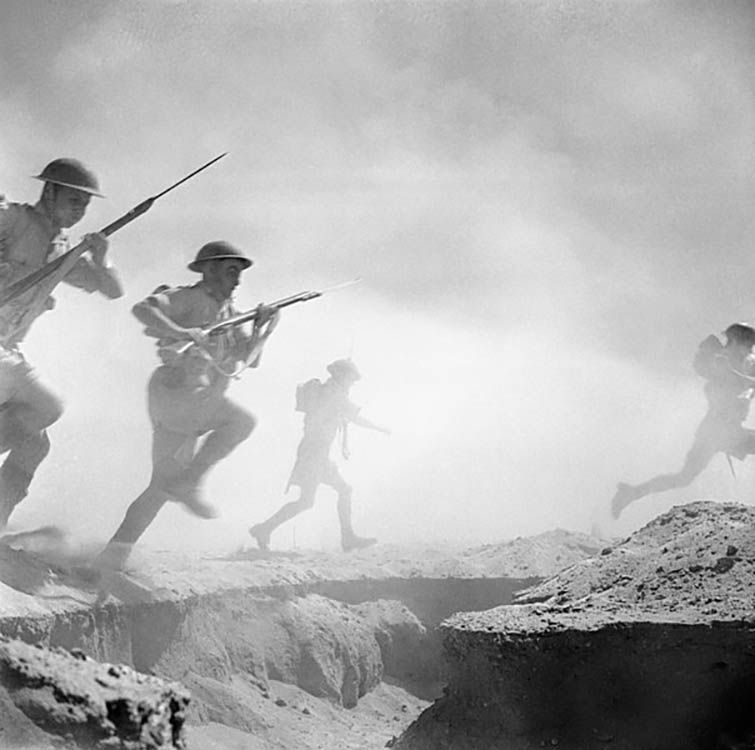
There had, however, been some more recent accomplishments. For example, Tobruk and El Alamein demonstrated clearly that the Germans could be beaten.
Following the El Alamein victory, Winston Churchill declared:
‘This is not the end. It is not even the beginning of the end. But it is perhaps the end of the beginning.’
Here, in those few meticulously-chosen words, Churchill acknowledged the 8th Army’s triumph, while making it clear that the fight was nowhere near over.
Russia, too, appeared to have reached a turning point in the war, with their crushing defeat of Germany’s forces at Stalingrad.

Nevertheless, the European mainland remained under German jackboots, and their heavily-defended ‘Atlantic wall’ continued to seem impenetrable, with no sign of a change. D-Day was still a year away.
Britons were war-weary and, despite historians’ subsequent assertions of the population’s grit, resolve, inner-strength and ‘Bulldog spirit,’ the government knew that it was vital that every effort be made to bolster morale.
By 1943, the entertainment industry had experienced a shift in its wartime role as, in a move to aid the war effort, it became more closely controlled by government. Through tight regulation and censorship, the industry became a vital tool in maintaining optimism and confidence by portraying the war positively.
At this time, the cinema was the most popular form of entertainment in Britain, and films were used to entertain, motivate and inform the population.
Films were therefore undoubtedly an important instrument for the distribution of propaganda.

The war not only impacted upon the ways in which cinemas were run, but also in the ways in which they were experienced. The history of wartime cinema-going may be considered to be a reflection of what it was like to live in Britain during a period of total war, a conflict which changed almost everything.

During this period, The Ministry of Information worked with the military to create a number of films for the cinema. Some of these were what would today be termed as ‘docudramas.’
These works depicted fictional accounts, portrayed in a real setting. They were, in effect, scripted documentaries and were geared to show a sanitised version of the conflict in such a way as to impart public confidence and bolster morale.

One of these films was the 1943 production, ‘Close Quarters,’ of which the film’s YouTube summary states:
‘This 1943 feature-length dramatisation follows the Royal Navy T-class submarine “Tyrant” on a routine North Sea patrol off the coast of Norway.
Like many British wartime movies, the cast of this feature film are the serving officers and crew.
It was also filmed aboard an operational submarine, offering a rare and detailed view of life in such complex, cramped quarters.’

Rather than use actors in this production, the vessel’s crew were portrayed by serving seamen. This undoubtedly imparts an authenticity to the the story.
The role of the film’s main protagonist – the fictional HMS Tyrant – was played by a Royal Navy T-Class submarine, HMS Tribune. This was of immediate interest to me, given that the vessel on which my father served (and had been the subject of my aforementioned post), was also a T-Class boat.

In ‘Close Quarters‘ our first sighting of the submarine is at its mooring alongside the depot ship, HMS Forth, in Holy Loch, close to Dunoon, Scotland. In the scenes that follow, we are presented with a clear indication of what it was like to serve within the claustrophobic confines of a WW2 submarine. Here, we see an actual crew performing their duties authoritatively and with calm efficiency.
It is this steady competence, spiced with good humour in the face of danger, that made this film, and others like it a morale boost for the people of Britain.
My only gripe with the film (and others of this era) is the hackneyed language. Dialogue is dull and threadbare, loaded with well-worn cliches and over-sentimentality. It is also presented by stereotypes: officers deliver their lines using the Higher Received Pronunciation, usually reserved for royalty, Noel Coward and the more affected element of the upper classes. The tone used by ratings, on the other hand, is strictly homespun and provincial.
This exaggerated juxtaposition, however, was the norm for the era, which today’s viewers perceive through very different lenses to those of the 1940s.

It cannot be denied that ‘Close Quarters’ certainly succeeds in delivering a ‘rare and detailed view of life in such complex, cramped quarters.’ One reviewer summarised the film by saying:
‘It is probably the most authentic footage of its kind and certainly better than even the best fiction films such as the highly-acclaimed “We Dive at Dawn”. Someone looking for a ‘good story’ might ridicule this, but anyone who knows anything about British WWII submarines would find this wonderfully authentic.
As there are no surviving examples of [T-Class submarines], this film is about as near as one will ever get to seeing them.’
Here then, courtesy of YouTube, and the Imperial War Museum is ‘Close Quarters‘:
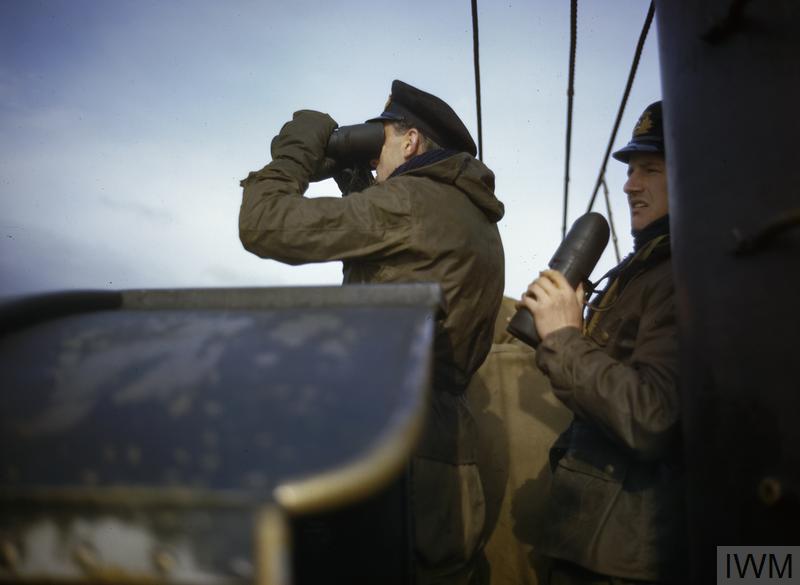
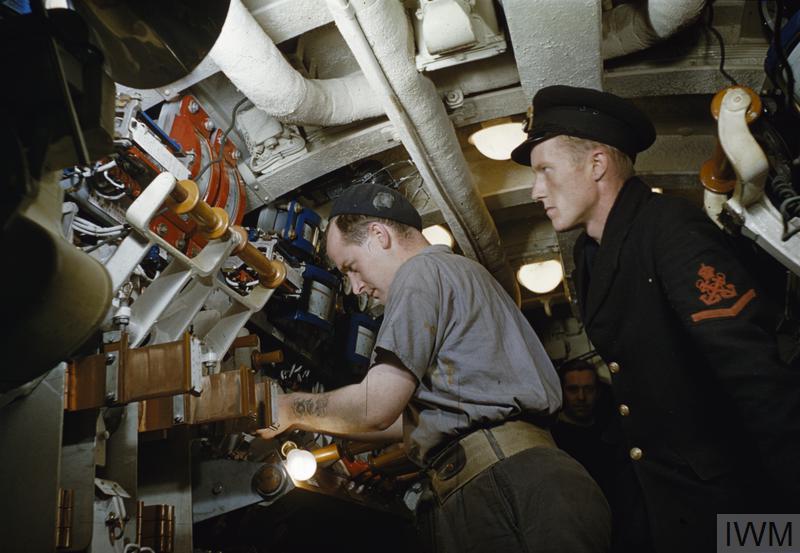
Should you not be tempted to view the movie, but would like to see its lead performer, HMS Tribune, both above and below deck, here are some still shots, taken by the production team:


Finally, I realise that, had it not been for the surveillance of my browsing activity, and the strategic use of internet AI, I may not have seen ‘Close Quarters‘, and this post would never have been written. I would, however, have been quite happy to sacrifice such ‘opportunities’ if that meant preserving my privacy.
 RAVEN MOON